One In 52

PAUL

Pick a card, as they say, any card.

INT. A MEDIUM-SIZED LECTURE THEATRE – DAY

PAUL, the lecturer, is standing at the front of an almost-full lecture room. The audience is almost entirely male. But PAUL is facing a female, seated, member of the audience.

PAUL

Do you want to change your mind?

She shakes her head.

PAUL(CONT’D)

Are you sure?

She nods.

V.O.

People never do change their minds. It doesn’t make a blind bit of difference to the trick. But still it would be nice if occasionally…

PAUL

Thanks, you can sit down. You’ve just told us that the Ace of Spades is your favourite card. It was your free choice, correct?

Without waiting for an answer PAUL walks along the front.

PAUL (CONT’D)

I need another volunteer. (Pause) You!

He points at a man on the front row.

V.O.

At school the troublemakers sit on the back row. With this crowd they sit at the front. It doesn’t matter. No one can mess up this trick.

PAUL mimes throwing something to the man.                 

PAUL

Catch!

The man mimes catching it. He looks sheepish. There are a few muted laughs among the audience.

PAUL (CONT’D)

That’s an ordinary deck of cards, right? Look through the deck. All different?

The man half heartedly mimes looking through the imaginary deck. PAUL looks into the audience.

PAUL (CONT’D)

How many cards in an ordinary deck of cards?

AN AUDIENCE MEMBER

Fifty two!

PAUL

Right. That was an easy question. Don’t worry, I won’t ask difficult ones. Trick questions maybe…(he looks back at the man with the invisible deck) Now shuffle the deck.

Both PAUL and the man mime shuffling a deck of cards. The man is warming up.

PAUL (CONT’D)

And fan it. (Pause) No! No! Turn it the other way around, I don’t want to see the cards!

The audience laughs. They’re warming up…at last, PAUL thinks. PAUL reaches out with his right hand into the imaginary deck and mimes moving his fingers back and forth among the cards. His fingers stop, and slowly he mimes pulling out one of the cards. He brings it close to his chest, hiding it from view with his left hand. He looks at the imaginary card, and then at the man.

PAUL (CONT’D)

You can put the cards down now, thanks.

He looks at the audience and nods slowly.

PAUL (CONT’D)

Now a slightly harder question. What is the probability that the card I have in my hand is our friend’s favourite, the Ace of Spades?

To be continued…

Swingers

This post looks at Mathematical Thinking, which we define as “The belief, especially characteristic of scientists, that events can be understood, described, and predicted using mathematical equations; thinking founded on this belief.” Sometimes it’s a good thing, sometimes not so good.

Imagine you’re at the bar, and order a gin martini. The bar man serves it in the usual conical martini glass. Tell us, when the drink is halfway down the side of the glass how much is left?

Half? No, the glass is pointy at the bottom so there’s clearly less in the bottom half than in the top half. A quarter? Final answer. One quarter!

Wrong.

You may recall from school the idea of similar triangles. They are triangles with the same shape, but a different size. This is what we also see in the cone, our martini glass. The bottom half of the martini glass is “similar” to the full glass.

The problem of calculating volumes of geometric objects goes back to the ancient Greeks. Draw a square on a piece of paper and then draw another with sides twice the length. How much has the area increased by? It’s four times bigger. You can see that four of the smaller squares will fit inside the larger. Now take eight sugar cubes or dice. Put four into a square and put another four on top. You’ve now got a larger cube, each side of which is twice the length of the smaller. So for a cube halve the length, you’ve got a volume that’s a mere eighth of the original!

The shape doesn’t matter here. All that matters is that the half-full glass is “similar” in the mathematical sense to the full glass. The formula is just 1 divided by 2 raised to the power d, where d is the number of dimensions. Since we live in d = 3 dimensions – we’re leaving out spooky extra dimensions – the answer is 1 divided by 2 cubed, which is 1/8, or 12.5%.

Or in mathematical terms: it’s time to order another.

Mathematicians are full of tricks like this where pure thought can lead to answers that are not otherwise obvious or where the brain gets tricked. Say that, reaching for a bottle on an upper shelf behind the bar, the barman’s arm brushes against a light hanging from a cable, making it swing gently. What is the time taken to swing left to right then back again (i.e. the period)?

Galileo first became interested in this problem when he noticed the sway of a chandelier in the Pisa cathedral. There are a few ways of solving it mathematically. Most require some knowledge of physical laws, but there is a simple method known as dimensional analysis that gets you most of the way there. As the name suggests, it is again based on the concept of dimension.

We first ask what quantities could affect the period of the swing. A couple are obvious: the mass of the weight, and length of the string. Anything else? The colour of the string or the time of day shouldn’t come into it, but one can imagine the answer is different on the moon from here in the bar so gravity must play a role. The acceleration due to gravity, usually represented by g, is 9.8 meters per second squared. On the moon it is only about 16 percent of that number, because the moon is less massive.

Now let’s postulate that the period is given by multiplying or dividing those numbers together, where again you are allowed to raise a number to a power. We will include fractional powers, so for example a number raised to the power ½ is the square root. The trick is that, for the formula to work, the units of the expression of the period, which are seconds, have to be the same as the units of the expression that you just made up. The two sides of the equation must be made of the same stuff.

The two sides of an equation must be made of the same stuff.

Write it out and you find that the only way to make it work is if – ta da! – the period of the swing is proportional to the square root of length divided by the gravitational constant g. So the mass doesn’t – and can’t – come into it.

There is no magic involved here, no spooky automatic writing or communication with the other side, but in a sense the result is magical, because it shows us something very counterintuitive, namely that the time of the swing doesn’t depend on the mass of the pendulum. The weight only comes in through the acceleration due to gravity. On the moon gravity is less and the swing will take longer. In fact, you can use this relationship to test tiny local perturbations in the gravitational field.

It turns out that if the length is exactly one meter, then the period T is almost exactly 2 seconds, and a single swing counts out a second. Which is why traditional grandfather clocks, first produced in the late seventeenth century, have a pendulum of this length. It also inspired the definition of the metre a century later.

This technique of dimensional analysis has been used to great effect in other circumstances. New Mexico was the site of the first explosion of an atomic bomb, at 5:29am on July 16, 1945. Codenamed “Trinity,” much of the project – including the amount of energy released by the explosion – was obviously kept secret. However one observer at the explosion was the mathematician GI Taylor. Taylor is famous for his work in fluid and solid mechanics, in particular the difficult problem of turbulent flow. He estimated the energy in the atomic explosion by applying precisely the above dimensional trick but with quantities energy, air density, radius of the explosion, and time. He estimated the energy released to be 17 kilotons of TNT. President Truman later revealed it to have been 22 kilotons. Taylor’s approximation was remarkably accurate and shows the power of quite simple mathematics, or perhaps more precisely the power of Mathematical Thinking. As we’ll see, similar thinking was behind the bomb itself – this is a dangerous kind of power.

Few people are as clever as GI Taylor. And unfortunately there are many people as gullible as Doyle. But there is also an intersection between magical thinking and mathematical thinking where the power and beauty of mathematics gets used as a decoy to confound while giving the illusion of clarity. We first discovered this happening in finance and economics. But once you’ve been alerted to the possibilities of such abuse you start seeing examples everywhere.

This is what we call Mathemagical Thinking. And in the wrong hands it can be as dangerous as nuclear weapons.

Magos

Magic and science have a surprising amount in common. They are both about telling a story, and constructing a narrative of events. In one, the story appears magical, in the other it appears mathematical, but that difference is less important than might appear. They can both be dangerous if misapplied. In fact, one could argue that science is truer to the spirit of magic than most modern magicians are.

Back in ancient Greece, where the term originates, the magos (magicians) were religious figures, like shamans, who were believed to have access to the Otherworld. They performed rituals and ceremonies, administered healing potions, cast spells on enemies, or contacted the dead through seances. They were not usually connected to official temples – who viewed them with suspicion – but operated as freelancers, selling their services in the private market.

Such gnostics and mystics have throughout history operated on the fringes of mainstream religion – with “superstitions” instead of official sacraments, and “witchcraft” instead of sacred rites. But they still had considerable knowledge and power, and were far more than a source of entertainment. They didn’t do children’s parties. And the separation between magic and science was not so clear.

Pythagoras, who is sometimes described as the first pure mathematician, ran what amounted to a pseudo-religious cult with all kinds of strange teachings and an interest in esoteric symbols. The first mathematical models of the cosmos were developed by Greek mathematicians expressly for the purpose of reading the future through astrology. Chemistry grew out of alchemy, whose practitioners included scientists such as Isaac Newton. In the late nineteenth century, the discovery of the cathode ray tube, with its eery green glow, seemed to excite the spiritualist community as much as it did the scientific community (though that changed when it became the basis for TVs).

Even today, science is often as much about putting on a great show and amazing us with magical demonstrations as it is about making life-altering discoveries. Consider for example the moon landing of 1969 (though some claim it was a staged illusion) which was actually about impressing the Russians with military technology. Or more recently the excitement about the discovery of a tiny ghostlike particle known as the Higgs boson, which sounds like something a wizard would concoct.

Perhaps the main difference now is that magicians are seen as mere paid entertainers, while scientists are revealing the deep truths of the universe. Our aim in this blog is to break down this barrier to show the still-powerful connection between magic and science. Through a sequence of stories, historical nuggets, magic tricks, and other amusements, we reveal some of the tricks that scientists play on their audience. And we will show how even in the modern scientific age, many people are prone to mathemagical thinking.

Automatic Writing

On the topic of gullibility, here is a story that we like to share with our banker friends during our “seminars” on magical thinking (much better paid than real magic shows and the audience is less demanding).

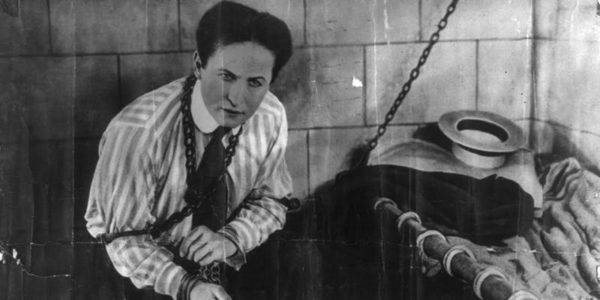
In the summer of 1922, Sir Arthur Conan Doyle invited his friend, the magician Harry Houdini, and his wife Bess to join them for a week at Atlantic City. The vacation was going well, and everyone was having a good time, until Sir Arthur suggested that his wife Jean could put Houdini in touch with Houdini’s beloved mother Cecelia, who had died almost a decade earlier.

Sir Arthur was of course famous for being the creator of the ultimate scientific rationalist Sherlock Holmes, however he had also been converted to spiritualism after losing his son and brother during World War I. When he saw Houdini perform his act during a tour through England, he became convinced that Houdini had genuine supernatural powers. And he had great faith in his wife’s talent as a medium.

For Houdini, the situation was complicated. For one thing, he knew that his illusions were the product of stagecraft, not magic, and that Sir Arthur was overly gullible. He had also authored a book in which he revealed the tricks of a number of magicians and mediums. It was inspired in part by earlier, unsuccessful attempts to contact his mother, who he had seen as “the guiding beacon of my life.” But at the same time, he liked Doyle – and he really missed his mother. So he agreed to give it a go.

The séance was held at the Doyles’ hotel room. After turning down the lights, Lady Jean went into what appeared to be a deep trance. Then she grabbed a pen and started scribbling manicly on sheets of paper – what spiritualists called automatic writing – as if she were channeling the spirit of Houdini’s mother. Houdini read the sheets as she finished them, fifteen in all before she wound herself down. But his awkward feelings were not relieved.

The letter said all the usual things that one might expect from a long-dead mother (love you, missing you, the Doyles are great, etc.) but it was written in perfect English (his mother was Hungarian and spoke little English), the first sheet was decorated with a cross (she was a Jew), she didn’t mention that it was her birthday that day, and so on. He didn’t need to be Sherlock Holmes to realise he was being conned.

Not wanting to spoil the evening, or their relationship, he didn’t say anything at the time; but matters came to a head later that year when he wrote an article saying that no medium had ever been proven to be able to contact the dead. Evidence-based, they were not. Doyle took it personally, and the friendship was effectively over.

Doyle continued to write books and give lectures promoting spiritualism. Houdini remained a skeptic, but still held out some hope that it might be possible to communicate with the departed – being a magician didn’t make him completely immune to magical thinking. He arranged a code with his wife, so that if she tried to contact him after his death through a medium she would know whether it was genuine. After he died in 1926, of a ruptured appendix on Halloween, Bess kept trying, but to no avail. She finally stopped the séances in 1936, famously announcing that “ten years is long enough to wait for any man.”

By that time, the craze for spiritualism was already losing some of its energy. And today, of course, most people see séances as something from an earlier, less scientific age. We know that for many people the desire to communicate with lost relatives is so great that they are willing to suspend disbelief; and that doing so makes them susceptible to the con-artists and fraudsters who Houdini had worked to debunk. But that doesn’t mean that we are immune to the power of magic – even when we are trying to be rational.

Bankers (and others) beware.

Throat Reading

Magic brings out the gullibility in people. This is good and is bad. It is good for magicians. But it is bad if powerful people are dumb. We can therefore use magic to figure out, to some extent, who are gullible.

Nobody is more powerful these days than bankers. So in some lectures I use tricks to their highlight gullibility.

My favourite is the following. (I write this like a screenplay, maybe a big a producer reads this blog.)

INT. LECTURE ROOM – DAY

PAUL walks among tables set out in CABARET STYLE. The seated audience members’ eyes follow him. PAUL is carrying a DECK OF CARDS? PAUL stops in front of one person and holds out the fanned deck face down.

PAUL

Pick a card, as they say, any card.

The audience member picks a card, and makes eye contact with PAUL.

PAUL (CONT’D)

Look at the card. Are you happy with your choice? Now please stand. And don’t let anyone see the card.

PAUL walks back to his desk at the front of the room and puts down the deck. He turns to face the audience.

PAUL [ADDRESSING THE AUDIENCE]

I want you all to help me. I’m no magician, I have no clue what card our friend is holding. But I think we can use science to figure it out.

PAUL turns to the subject holding the card.

PAUL (CONT’D)

When I tell you I want you to shout out the name of the card as loudly as possible but only in your head. Got that? Only in your head. Please don’t say anything out loud. Just scream it inside your head. You look like the sort of person who screams internally a lot. That’s why I chose you.

After a short pause PAUL grins. The subject smiles weakly back.

PAUL (CONT’D)

Ok. Scream!

Nothing happens. But PAUL turns excitedly to look at the audience.

PAUL (CONT’D)

Did you see that? Yes? No? It’s difficult until you’ve had practice. Just look at his throat. Let’s try that again. This time please only shout the suit of the card. And everyone focus on his throat. Go!

PAUL is clearly excited.

PAUL [ADDRESSING THE AUDIENCE]

You saw it that time, no? Did you see his throat move, ever so slightly but just enough. What do you think? Spades, hearts, clubs, diamonds? What did you see as his throat moved?

No one says anything.

PAUL [POINTING AT ONE AUDIENCE MEMBER]

What do you think? Spades?

There is no reaction from the audience member.

PAUL (CONT’D)

I don’t think that’s it. Who thought Hearts?

Still no audience reaction. But PAUL nods at a few people. Clearly this crowd is a bit shy. Sometimes you have to pretend to get responses from the audience just to get the party going.

PAUL (CONT’D)

You did? Yes. And you? So maybe half of you thought he shouted Hearts. [NOW ADDRESSING THE SUBJECT] Are they right? Was it Hearts?

SUBJECT

Yes.

I continue in this vein, moving on to the number of the card, and the audience seems to agree that the card is the Five of Hearts. Amazingly this turns out to be correct. This “Throat Reading” is very powerful.

If you google “throat reading” you’ll find lots of comparisons with Neuro Linguistic programming (NLP), how it’s important to work with the right subject, how it works best if the subject is slightly tense (so it’s particularly good in the above setting), how the first language of the speaker makes a big difference (Dutch speakers are apparently the easiest to read), and so on. Research goes back to the 1950s, and there’s even some association with the MKUltra project. Apparently one could extract information from individuals under the influence of certain drugs, mescaline for example, even if they didn’t actually speak! Subjects can maintain control of their breathing but the drugs weaken their control of the larynx. And so you can observe movement, and with skill interpret what they aren’t saying out loud.

How gullible can you be?

Oh, come on! You didn’t fall for all that science nonsense did you? You’re a sucker for a bit of scientific mumbo jumbo then? No, surely you, dear reader, know that it’s all total baloney? If you do google “throat reading” all you’ll see are links to the British mentalist Derren Brown (there’s a YouTube video). No, this is a card trick, goddamit! And pretty elementary, like all of my tricks. (DB and I created this presentation independently, FYI.)

I know from doing this simple trick at my lectures that a decent portion of my audience will fall, hook, line and sinker, for the scientific explanation. Many will be unsure. (Most will be thinking when is the next tea break.)

Mathemagical Thinking Lesson

Ok, so no mathematics here, just pseudoscience. I use this trick to show people just how easy it is to be gullible. I hope it gets my audience into the right state of mind to start to question standard practices and received wisdom.

People like the idea of “tells,” body language. What were Harry and Meghan thinking during their Oprah interview? If anything. This trick taps into that. And notice how I threw in a bit of conspiracy stuff, MKUltra. That also appeals to a certain, frighteningly large, audience.

A Trick With Horses

I am going to teach you a trick with horses. You can do it at home if you have enough horses. This old trick was famously done by TV’s Derren Brown.

We will run a with race with two horses, we can use more horses but with two it is easiest to explain. First find the names and addresses of 1024 people. Write to 512 to say horse A will win the race. To the other 512 say that horse B will win. Say horse B wins. Throw away the names of people to whom you said horse A would win. Next week, new race. To 256 of the remaining 512 say that horse C will win and to the other 256 say horse D. Horse C wins. Throw away the names of the people you gave the wrong prediction to. Same again the following week. Now there will be 128 people you have given a winning horse to three times. Do it again, 64 people and four wins. Then 32 people and five wins. And so on. Eventually there will be one person who thinks you are most amazing expert in horse racing, you have predicted 10 winners in 10 races. They are now primed for the big scam.

On TV, Derren gets this one person to bet all their life savings on the next race, on his prediction. And the sucker loses. Derren is distraught. This all makes great TV.

It has a happy ending though, because Derren has in secret bet on the horse that actually won, and he gives his winnings to the aforementioned sucker. So everyone is happy. (Of course, in secret Derren had bet on all the horses in this last race, so he can’t lose. They don’t show this on the TV though.)

In statistics this trick is a bit like what called is “p hacking.”

A scientist says he is 95% confident that eating peas causes spots. Where did he get that 95% from? He does lots of statistics on lots of data involving people who do and don’t eat peas. He writes research papers, becomes famous in the vegetable community and is hired by the Cabbage Marketing Board to promote the health advantages of cabbage. Cabbages good, peas bad.

Problem is that for years he does this research on many people, and many vegetables. He studies 1,000 people, and none of them show any bad effects from eating parsnips or mange tout or carrots. Not even broccoli. This is no good, he cannot write a research paper saying vegetables are good for you. Everyone does that. So he finds another 1,000 people. And then another 1,000. Then just 500. Or 200. With a small number of people he is more likely that one of them will be the school boy who allergic to everything. So one day, hurray, he find some very spotty people in his small sample. It had to happen eventually. Naughty scientist.

Mathemagical Thinking Lesson

You see this a lot with beauty products for which there are lower standards for claims than with, say, medical products. Look out for the small print telling you how large was the sample of people used in the trial. Eight out of 10 cats etc. Is that 80% of 10,000 cats? Or maybe just four out of a sample of five cats.

Are you looking into which school to send your genius progeny? You might find that a fairly local school has a very high recent ranking, as measured by exam results. But is that because that local school is very small and has one particularly bright child in one year? One out of a small sample, one is relatively large compared to one out of a large sample. As soon as that child leaves the school will fall back in the ranking.

Houdini – The Master Of Topology

Little known fact – in which we specialize – Houdini could have been a great mathematician. Specifically a topologist. Escapology, topology, there are great similarities. Topology is the mathematical study of shapes and spaces. I don’t know much about it. It seems to involve eating a lot of donuts. Or knitting. (But, have you noticed,  there’s never a topologist to be found when it’s time to untangle the Christmas tree lights.)

But why was Houdini so good at topology? Well, Houdini is famous for many daring escapes, from boxes, from milk churns, jail cells, handcuffs. You can buy a set of shackles here so you can do a spot of escapology yourself. (Note: Do not try this at home. Even more important, don’t try this inside a box at the bottom of the East River.) You can have a member of the audience, or a close personal friend, padlock your hands behind your back using two real padlocks, there is no trick here, they are real padlocks. And in one second you escape. How is this possible? With topology, of course. Should I give away the secret? I will give you a hint below.

I once tried escapology. When my legs were more bendy than they are now. Here is the true story of my escape from a holdall, filmed for national television in the United Kingdom. It has an unhappy ending, but not for the obvious reason.

In 2010 we hear of the death of Gareth Williams, a mathematician working for UK GCHQ. He is found naked inside a red holdall, padlock on the outside, key on the inside. Because he worked for British “spies” people say that he must have been murdered.

There is an inquest and several experts say it is impossible for a man to get inside this type of bag, and close it so that the padlock is on the outside. They squeeze, they bend, they cannot do it.

At the time that the inquest results were announced I happened to be in my living room with a reporter friend. “I can do this!” I said to him immediately. I showed my friend the principle using that $20 Houdini shackle linked above. We then ran around London trying to find a red North Face holdall, the type in which Mr Williams was found. At last we found one in a shop in Kensington. (The shopkeeper said that a Sky News reporter bought one too just before, they must also know the trick. The race is on!)

We go to my flat and I try to get into the bag. It is very hard work. I am not as young as I used to be.
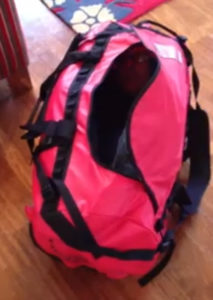
Look closely, you can see me in the bag.

But after 20 minutes I am in the bag and the bag is locked. The key is on the inside. The padlock on the outside. Exactly the condition in which Gareth Williams was found. It is very hot, and very difficult to breathe. And please note, my stomach is considerably bigger than Gareth Williams’, I have not exercised for 30 years, I was much older. I have dodgy shoulders. And because my friend is watching I still have my clothes on. But I did it.
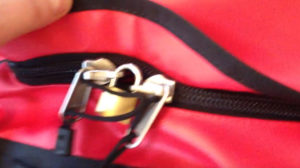
I am locked in a bag.

The friend and I go to Channel 4 where he works. We tell the news people our discovery. They set up a camera. We are all ready. Health and safety documents signed. Three keys to the padlock are all outside the bag ready for them to open it. I do it again. Not quite so good this time. I slip a bit and the padlock is half in and half out of bag. But unfortunately the hole of the padlock is inside the bag and all keys are outside. I think this is funny. For a while. They slip the key into the bag and I open it. Channel 4 want me to try again. But I am too exhausted. So I end up on the cutting-room floor! (Another person tried the same trick a few weeks later, and got loads of publicity. She was a short teenager. She would have fitted inside a lunchbox.)

What can we learn from this? Experts, phooey! Mathematicians are experts, magicians are experts. Judges should speak to mathemagicians.

So what is the trick of topology? It is easy. First open the zip. Then bend bag/zip around until the two ends of the zip touch. The whole zip should form a large loop. Now put the padlock through the two pull tabs at the ends of the zip. So the padlock is on but the zip is still open. Now pull the two tabs together, making sure that the padlock is outside the bag as you do this. (Also have a key inside and another key outside, just in case. And maybe a strong knife and scissors.)

So what happened to poor Gareth Williams? Some say it was the Russians.  Me, I think he was experimenting, he was curious.

Mathemagical Thinking Lesson

In mathematics we have the concept of Proof by Existence. It’s probably the easiest type of proof to understand. Example: Prove that there is an integer solution of 

x^2-3x+2=0.

Prove it! That’s an easy one, try x=1. There, done!

Outside mathematics someone says something can’t be done, and then someone does it, that’s an existence proof. The proof doesn’t have to be constructive, i.e. we don’t need to know how it’s done, only that it has been done. “Houdini can’t escape from his water torture cell!” Well, he did. We don’t know how (or rather, we didn’t at the time), but we know a solution exists.

That’s were we sort of are with the Gareth Williams case. I say “sort of” because it wasn’t done under exam conditions, so to speak. So it’s reasonable to ask for another demonstration. And at least two people have done this while being observed. So it cannot be said that “This cannot be done.”

A book was published recently about the Gareth Williams case in which the author said he had tried “300 times” to get inside a holdall and lock himself inside. Therefore it cannot be done he said. I don’t think he mentions whether he has also tried to split the atom 300 times and failed.

This is all very annoying to the obsessive mathematician. The saying of maybe Carl Sagan, maybe Martin Rees, maybe William Wright, “Absence of evidence is not evidence of absence,” has clearly not caught on among the general public.

It’s also a very defeatist position to take. Only mathematicians, and not mathemagicians, should be allowed to say “It can’t be done,” and then only in relation to mathematics. If everyone said “It can’t be done,” we would all still be living in caves, and not on the way to Mars. Actually, language might not even exist, so we wouldn’t even be able to say “It can’t be done.” But that’s one for the philosophers.

A Trick With Dice

Ten is bigger than five, and five is bigger than one. And so ten is bigger than one. Basic stuff. In symbols (we mathematicians like symbols, more than we like numbers):

If A > B and B > C then A > C.             (*)

This is common sense. Wait, not so fast! (There is no such as thing as common sense to mathematicians.) This is not true for everything.

Do you play Rock, Paper, Scissors? Rock beats Scissors, Scissors beats Paper. In symbols

R > S > P

But it is not true that R > P. Because Paper beats Rock.

R > S > P > R > S > …

When something obeys (*), as numbers do, then we call that Transitive. But like Rock, Paper, Scissors there are many fun things that are not transitive, and some of them even involve numbers, in a way. And can even be used to win drinks at a bar. (This could turn into a theme.) Let’s see an example.

You play games with dice, then you are used to the standard dice with six sides, numbered 1, 2, 3, 4, 5, 6. Each side equally likely to be rolled. We are going to roll dice, you and I, to see who pays for the drinks. But we aren’t going to use regular dice. They will be six sided and they will be unbiased. But we are going to use six-sided dice with slightly different numbers on them. Here are three such dice:

A: 1, 1, 3, 5, 5, 6

B: 2, 3, 3, 4, 4, 5

C: 1, 2, 2, 4, 6, 6

We each choose a die, we roll. If we draw we roll again. Loser pays for the drink. All the dice are very similar, no? The pips on all the dice add up to 21, so the mean roll is 21/6 = 3 1/2, just like for a regular die.

I am feeling generous, I will let you choose your die first. You choose A? Ok, I choose C. Who wins most often? You’d think that would be equally likely to win because the means are the same, no? No! Look at table:

1 1 3 5 5 6
1 D D L L L L
2 W W L L L L
2 W W L L L L
4 W W W L L L
6 W W W W W D
6 W W W W W D

Along the top is your roll, die A. Down the left-hand side is my roll, die C. Thirty-six possibilities, out of which I win 17, you win 15, and there are four ties and we roll again. And this is true whichever die you choose. Choose B and I choose A, choose C and I choose B. Every time you pay for more drinks than me! Ok, so not a big advantage but it adds up over a typical lock-in session.

Warren Buffett is big fan of non-transitive dice. I don’t know if he is a big drinker.

Mathemagical Thinking Lesson

What can we learn from this? Other than don’t go to a bar with me. The most important lesson is that what happens on average does not give us the whole picture. All these dice have the same mean roll. That is irrelevant. What about other types of average? The median is the middle number in an ordered list. Die A has a median of 4, die B 3.5 and die C 3. Now there are differences, perhaps you’d choose die A. Doesn’t matter. Similarly the modes are different. The mode is the most frequent number, here all dice are bimodal, and are different. But again that form of average is irrelevant.

Normally we are great fans of common sense. But sometimes common sense can be highly misleading. Sometimes you have to ask questions that defy common sense.

See also the excellent essay by Stephen Jay Gould, “The Median Isn’t the Message,” https://journalofethics.ama-assn.org/article/median-isnt-message/2013-01

Magic Is A Sufficiently Advanced Technology

I have a saying, it is “Magic is indistinguishable from a sufficiently advanced technology,” which is very close to something Arthur C. Clarke said which is “Any sufficiently advanced technology is indistinguishable from magic.” Ok, I stole his saying and reversed it, I confess.

Sadly it is true. In olden times magicians would make balls levitate and float across audiences. It was a trick involving wires and threads. But you knew that. Now you can buy drones that do the same thing. Look at airhogs.com. Where is the magic in that?

In those good old days we read an audience member’s secret writing hidden inside an envelope using skills perfected over decades. (Often involving peaking. Actually always involving peaking.) Now you can buy writing pads that will transmit any drawing to a video screen on your wrist.

Cold reading an audience required psychological insights, and cojones of steel. “Is there anyone here called Margaret?” (I suspect Margaret is a very common name for an audience member at this sort of event.) But now I can see the names of people paying by credit card. I look at them on Facebook. Now I can say “Is there anyone here called Margaret, who went on holiday to Ibiza with friends and kissed a Spanish waiter?” Too easy. There’s no skill anymore.

What do you want, Instagram or magic? You can’t have both.

A Trick With Money

Everyone loves money! Everyone loves magic! Everyone loves mathematics!

Sadly not all of this is true. Actually most of it is not true. Imagine how difficult it must be for David and me to earn a living. Here is a trick we use in bars when people are very drunk. And we are desperate for cash.

We say to a drunk person, “Here are 20 coins, all showing heads. While I look away you turn over eight of them to show tails. I will keep looking away, you can even blindfold me, and I will divide the coins into two piles, each having the same number of tails face up. If I can’t do it you keep the 20 coins. If I can then you give me the same amount. Deal or no deal?”

How is this possible? How can we get two piles with same number of tails if we can’t see anything?

I will give the solution and then prove it is possible by algebra. Algebra is when you use letters instead of numbers. We’ll talk about symbols mathematics and numbers mathematics later.

But would you mind taking just a minute or two to have a go yourself? I know, I know. I also hate it when I’m asked in a book to spend a minute breathing deeply, or making a list of all the things I’d like to change about myself. But we aren’t going to do this often. Honest.

Ok, the solution. All you have to do to win the money from the drunk person is to move any eight of the coins to another pile, and turn all of them over. You will see that both piles have the same number of tails. Ok, it won’t be four in each pile, maybe that is what you expected. But I did not say that.

Here is the mathematical proof in a table. We don’t have to use 20 coins and turn over eight. Here we start with m coins and turn over n. When we move n into the new pile (on the right) x is the number of heads that get moved across, we don’t know what this number is but it doesn’t matter. See how the number of tails, coloured red, is the same on the left and the right. And it doesn’t depend on m or n.

LEFT PILE RIGHT PILE
Heads Tails Heads Tails
Initially m 0
Turn over n m-n n
Move n to another pile m-n-x n-(n-x) x n-x
Turn over right pile m-n-x n-(n-x) = x n-x x

Usual deal, if you do this in a bar and win then I get my 10% commission. If you mess it up and lose, I don’t pay you. It’s a bit like the performance-related pay in a hedge fund.

Mathemagical Thinking Lesson

This lesson is about thinking in different domains.

Did you figure out how to do trick? If you hadn’t then I wonder if it would have been easier if we’d used the numbers five and two instead? Or even two and one! What about 137 and 59?

With two and one, I think you would have got it. But then it wouldn’t have looked special, just dumb. With five and two you might have got the solution if you could be bothered. With 20 and eight we reckon you might have given up. That they are both even numbers and there are two piles might seem to be a clue, but is misleading. But then with 137 and 59 you might have thought there’s something special about those two numbers, maybe it’s all about prime numbers. Now there’s a garden path you wouldn’t want to be led along.

The mathematician has two ways to approach this.

The first method: Given the 20/eight version the mathematician might wonder if the numbers are special. If not, then they’d reduce the problem to the two/one version. Then move on to three/one, etc. Then 20/eight and finally the general solution, using letters instead of numbers.

The second method isn’t just for mathematicians, and is the way I approached it initially. We have four numbers to play with: Four (half of eight…there’ll be two piles); Six (half of 20-8); Eight; And 10 (half of twenty). (Twelve isn’t special, moving 12 is the same as moving eight.) And there’s one optional thing to do, turn coins over. There aren’t many experiments to go through. Moving four and turning them over is quickly shown to not work. And moving and turning eight works. Solution found.

We’ll talk about numbers people and symbols people later. There is a great advantage to being able to think in both domains. The mathemagician knows this, and knows how to distract either with the tedium of dealing with numbers or the fear of dealing with symbols.