Fooling Churchill

The magician Paul Curry created the following trick known as either “Out of This World” or “The Trick that Fooled Churchill” since it was supposedly performed for him during the war.

The Effect

The Magician holds a pack of cards and deals out one red and one black card face up side by side. These are the ‘header cards.’ He hands the deck to the Subject and asks him to deal the cards one at a time face down and try to intuit which cards are red and which black and put them face down under the corresponding face up header card. Half way through the deck the Magician takes back the cards, puts down two new header cards and asks the Subject to continue. The reason for this interruption might be something about eliminating left/right bias. When the Subject has finished the Magician picks up the groups of cards, turns them over and reveals that the Subject has somehow got every single card right!

This can be passed off as a pure magic trick or as a demonstration of Extra Sensory Perception, ESP.

The Method

The deck is set up initially so that all reds are in the top half and all blacks at the bottom. As the Subject randomly puts down the first half of the deck into two columns the Magician has to keep count so that he knows when the red cards end and the black begin. Leaving one red card for a new header, the Magician puts down a face up red, and a face up black card. (Obviously this should be done with some fiddling through the cards so that it looks like the Magician doesn’t himself know which are red and which black.) The Subject then continues with the division of the face down cards into the two piles. Now it’s just a matter of the Magician picking up the cards in a way that distracts the Subject from the fact that the he is swapping piles over.

It is possible for the Subject to place the cards as if they are all red or all black. This would clearly mess up the Effect and so requires some handling by the Magician. The Magician can also intervene a few times, as a gag, to say “Just a second, I think that one is wrong. Do you mind if I move it to the other column? But I think generally you’re doing great!”

Penney’s Game

Here is a trick you can do with pennies. It is called Penney’s game. It is named after Walter Penney. Or was he named after the game? No one knows.

You choose a sequence of heads and tails, three in total. Say HHH. I then choose another sequence, say THH. We now toss a coin over and over, noting the order of heads and tails. If your sequence occurs first then you win, if mine then I win.

Now surely is obvious that both players have an equal probability of winning? Simply because heads and tails are equally likely, as are all the combinations of the three in the sequence. But this not obvious to the mathematician. And here the mathematician is right.

(If you thought equally likely then I’ve got a bridge to sell you.)

Mathematicians never take anything for granted. Even the most obvious idea must be rigorously proved before the mathematician can get any sleep. Here’s something that surely is obvious, but turns out not to be. And it makes a great trick to play in a bar. Yes, another one. Some people say I spend too much time in bars. I say, “Your round.”

With the two sequences chosen here, the first player has HHH and the second THH, the second player has a seven in eight chance of winning. Now how can that be?

We can see this easily with the above choices for the two players. If ever a T is tossed then the first player cannot possibly win:

XXXXXTHH

has to come before

XXXXXTHHH.

Therefore the only way the first player can win is if the first three tosses are all heads, which has a small one in eight chance. The same principle applies to other combinations, albeit not so trivial to demonstrate. In this table we see how the second player should choose his sequence to maximize his probability of winning:

1st player’s choice 2nd player’s choice Odds in favour of 2nd player
HHH THH 7 to 1
HHT THH 3 to 1
HTH HHT 2 to 1
HTT HHT 2 to 1
THH TTH 2 to 1
THT TTH 2 to 1
TTH HTT 3 to 1
TTT HTT 7 to 1

If you want to play this in a bar then the way to remember the optimum is take the first player’s second choice, swap it (from H to T or vice versa) then add on his first two choices.

One In 52 Continued

Before we explain the significance of this question you’ll need some background. I am giving one of my training courses to a group of investment bankers, hedge fund managers, risk managers, regulators, anyone with an interest in the mathematical side of finance. The audience will be mostly those with an economics or finance degree, some scientists, with the occasional lawyer. I know this sort of audience well. I know that they’ll have a pretty decent grasp of some narrow areas of mathematics and statistics, but they’ll probably wildly overestimate their abilities. And despite their six-figure salaries they won’t know when and where to apply what mathematics they do know. With this trick I’m hoping to hammer home asap that there’s more to the application of mathematics than what you find in the text books. And I’m warming my audience up. Lectures with audience interaction are more memorable than those without. And those with the invisible deck of cards are even better.

I started this segment of my course by asking the audience to imagine that they are at a magic show. I then ask someone to name their favourite card. Then by getting them to say how many cards there are in a normal deck I make the final question look like it is about probability theory, “What is the probability that…?” And people working in finance, like this audience, use probability theory and assumptions about the stock market’s random behavior as their very bread and butter. One of the most famous, non-technical, books on the mathematics of the stock market by Burton Malkiel is even called “A Random Walk Down Wall Street.”

But it’s too easy to fall back on mathematics if that’s your field of expertise. And sometimes that mathematics might not only be irrelevant, but also dangerous.

As we’ll see, context is all when it comes to mathematics, and magic.

We’d like you, fragrant reader, to take part in my exercise. Imagine you are in the audience, imagining you are at a magic show. What do you think is the probability that the card that I have chosen is the Ace of Spades? (Yes, yes, we know I didn’t really do the trick, I pretended to do the trick. So I could just as easily pretend to cheat. But we want you to imagine you are in the audience of a real magic show, and the real magician has a real deck of cards. One day I will learn how to do this trick properly myself.)

The question to you is what is the probability that the card taken from the deck is the Ace of Spades?

Think about this question while we talk a bit about risk management. Feel free to interrupt as soon as you have an answer. Oh, you already have an answer? What is that you said, one in 52? On the grounds that there are 52 cards in an ordinary pack. It certainly is one answer. But aren’t you missing something, possibly crucial, in the question? Ponder a bit more. Clue: Context.

One aspect of risk management is that of “scenario analysis.” Risk managers in banks have to consider possible future scenarios and the effects they will have on their bank’s portfolio. They like to assign probabilities to each event and then estimate the distribution of future profit and loss. Of course, this is only as useful as the number of scenarios you can think of. And you need to know those probabilities.

You have another answer already? You’d forgotten that it was a magician pulling out the card. Well, yes, we can see that might make a difference. So your answer is now that it will be almost 100% that the card will be the Ace of Spades, a magician is hardly going to get this trick wrong. That’s quite a different answer from the one in 52. Are you right? Well, think just a while longer.

Sometimes the impact of a scenario is quite easy to estimate. For example, if interest rates rise by 1% then the bank’s portfolio might fall in value by so many hundreds of millions. But estimating the probability of that interest rate rise in the first case might be quite tricky. And more complex scenarios might not even be considered. What about the effects of combining rising interest rates, rising mortgage defaults and falling house prices in America? That’s less a matter of probabilities than, with hindsight, an inevitability. And by assuming that the laws of probability trump causality leads to overconfidence that all is well with the world.

Most mathematically inclined finance people when asked the magician question, usually give the one in 52 answer – because they ignore the context, it’s a magic show. It often requires quite an awful lot of major hinting before the “quants,” the banks’ tame mathematicians, even begin to think beyond pure probability, and bring in context. Rather frighteningly, some people trained in the higher mathematics of risk management still don’t see the second answer, the 100%, even after being told. It’s as if the context is irrelevant. Or they willfully ignore the context to keep it to a nice simple question in probability theory. Heaven forbid that they should consider messy reality.

I have asked this question at many risk-management events, so I have some idea of the statistics of the answers versus the make-up of the audience. I once asked the question at an actuarial conference. Out of the audience of one hundred there were two who absolutely and categorically refused to entertain the idea of anything other than the grade-school one-in-52 answer. No amount of discussion of context and the reality of magic shows persuaded them to even entertain the possibility of another answer. One member of that audience shouted out “Those two work for a regulator!” I thought this was a joke. But it wasn’t. Seriously, the only members of the audience stuck on the mathematics, unable to see the context, were the only two from a financial regulator. Surely regulators more than anyone must consider reality rather than theory? Apparently not. These two regulators were asked to justify their answers. Their explanation involving concepts from higher probabilistic mathematics was met with hoots of amusement from the rest of the audience.

Actually there is no single, correct answer. This is really an exercise in creative thinking – and non-mathematicians are usually better at spotting this. And creative thinking is something that risk managers and regulators need to get good at. (And less of the creative accounting.)

For example, one possible answer to our card-trick question is zero. There is no chance that the card is the Ace of Spades. I usually reveal that the card I pulled from the deck is… “The Three of Clubs! D’oh!” Has the trick gone wrong?

This trick is too simple for any professional magician. Maybe the trick is a small part of a larger effect, getting this part “wrong” is designed to make a later feat more impressive … the Ace of Spades is later found inside someone’s pocket. Or, our favorite, tattooed on the magician’s arm. Very, very rarely does anyone ever think of these possibilities. (And if you did, then you should be in the Magic Circle.)

The answer one in 52 is almost the answer least likely to be correct. Magicians rarely rely on probability.

Risk management requires an open mind – but a traditional education in finance often works to close it.

So, what was your final answer?

Did you say one in 52, and stick with that answer? You are going to be one tough critic then.

Did you say one in 52 and then change your mind? Good, we can work with you.

Did you say 100%? Excellent.

Did you say zero? We don’t believe you! (You’re not David Blaine are you? We know he’s a fan but…)

Did you say 37.26%? Interesting.

Running with the idea that the magician deliberately gets the card wrong in an end-of-second-act cliffhanger there is the tiniest of probabilities that he fails…i.e. he unintentionally picks out the Ace of Spades. The correct card. And what’s the probability of that? One in 52! We’re back where we started. Does your brain hurt yet? I have never known anyone to take the analysis and the context as far as this. If you did then we definitely want to hear from you.

One In 52

PAUL

Pick a card, as they say, any card.

INT. A MEDIUM-SIZED LECTURE THEATRE – DAY

PAUL, the lecturer, is standing at the front of an almost-full lecture room. The audience is almost entirely male. But PAUL is facing a female, seated, member of the audience.

PAUL

Do you want to change your mind?

She shakes her head.

PAUL(CONT’D)

Are you sure?

She nods.

V.O.

People never do change their minds. It doesn’t make a blind bit of difference to the trick. But still it would be nice if occasionally…

PAUL

Thanks, you can sit down. You’ve just told us that the Ace of Spades is your favourite card. It was your free choice, correct?

Without waiting for an answer PAUL walks along the front.

PAUL (CONT’D)

I need another volunteer. (Pause) You!

He points at a man on the front row.

V.O.

At school the troublemakers sit on the back row. With this crowd they sit at the front. It doesn’t matter. No one can mess up this trick.

PAUL mimes throwing something to the man.                 

PAUL

Catch!

The man mimes catching it. He looks sheepish. There are a few muted laughs among the audience.

PAUL (CONT’D)

That’s an ordinary deck of cards, right? Look through the deck. All different?

The man half heartedly mimes looking through the imaginary deck. PAUL looks into the audience.

PAUL (CONT’D)

How many cards in an ordinary deck of cards?

AN AUDIENCE MEMBER

Fifty two!

PAUL

Right. That was an easy question. Don’t worry, I won’t ask difficult ones. Trick questions maybe…(he looks back at the man with the invisible deck) Now shuffle the deck.

Both PAUL and the man mime shuffling a deck of cards. The man is warming up.

PAUL (CONT’D)

And fan it. (Pause) No! No! Turn it the other way around, I don’t want to see the cards!

The audience laughs. They’re warming up…at last, PAUL thinks. PAUL reaches out with his right hand into the imaginary deck and mimes moving his fingers back and forth among the cards. His fingers stop, and slowly he mimes pulling out one of the cards. He brings it close to his chest, hiding it from view with his left hand. He looks at the imaginary card, and then at the man.

PAUL (CONT’D)

You can put the cards down now, thanks.

He looks at the audience and nods slowly.

PAUL (CONT’D)

Now a slightly harder question. What is the probability that the card I have in my hand is our friend’s favourite, the Ace of Spades?

To be continued…

Throat Reading

Magic brings out the gullibility in people. This is good and is bad. It is good for magicians. But it is bad if powerful people are dumb. We can therefore use magic to figure out, to some extent, who are gullible.

Nobody is more powerful these days than bankers. So in some lectures I use tricks to their highlight gullibility.

My favourite is the following. (I write this like a screenplay, maybe a big a producer reads this blog.)

INT. LECTURE ROOM – DAY

PAUL walks among tables set out in CABARET STYLE. The seated audience members’ eyes follow him. PAUL is carrying a DECK OF CARDS? PAUL stops in front of one person and holds out the fanned deck face down.

PAUL

Pick a card, as they say, any card.

The audience member picks a card, and makes eye contact with PAUL.

PAUL (CONT’D)

Look at the card. Are you happy with your choice? Now please stand. And don’t let anyone see the card.

PAUL walks back to his desk at the front of the room and puts down the deck. He turns to face the audience.

PAUL [ADDRESSING THE AUDIENCE]

I want you all to help me. I’m no magician, I have no clue what card our friend is holding. But I think we can use science to figure it out.

PAUL turns to the subject holding the card.

PAUL (CONT’D)

When I tell you I want you to shout out the name of the card as loudly as possible but only in your head. Got that? Only in your head. Please don’t say anything out loud. Just scream it inside your head. You look like the sort of person who screams internally a lot. That’s why I chose you.

After a short pause PAUL grins. The subject smiles weakly back.

PAUL (CONT’D)

Ok. Scream!

Nothing happens. But PAUL turns excitedly to look at the audience.

PAUL (CONT’D)

Did you see that? Yes? No? It’s difficult until you’ve had practice. Just look at his throat. Let’s try that again. This time please only shout the suit of the card. And everyone focus on his throat. Go!

PAUL is clearly excited.

PAUL [ADDRESSING THE AUDIENCE]

You saw it that time, no? Did you see his throat move, ever so slightly but just enough. What do you think? Spades, hearts, clubs, diamonds? What did you see as his throat moved?

No one says anything.

PAUL [POINTING AT ONE AUDIENCE MEMBER]

What do you think? Spades?

There is no reaction from the audience member.

PAUL (CONT’D)

I don’t think that’s it. Who thought Hearts?

Still no audience reaction. But PAUL nods at a few people. Clearly this crowd is a bit shy. Sometimes you have to pretend to get responses from the audience just to get the party going.

PAUL (CONT’D)

You did? Yes. And you? So maybe half of you thought he shouted Hearts. [NOW ADDRESSING THE SUBJECT] Are they right? Was it Hearts?

SUBJECT

Yes.

I continue in this vein, moving on to the number of the card, and the audience seems to agree that the card is the Five of Hearts. Amazingly this turns out to be correct. This “Throat Reading” is very powerful.

If you google “throat reading” you’ll find lots of comparisons with Neuro Linguistic programming (NLP), how it’s important to work with the right subject, how it works best if the subject is slightly tense (so it’s particularly good in the above setting), how the first language of the speaker makes a big difference (Dutch speakers are apparently the easiest to read), and so on. Research goes back to the 1950s, and there’s even some association with the MKUltra project. Apparently one could extract information from individuals under the influence of certain drugs, mescaline for example, even if they didn’t actually speak! Subjects can maintain control of their breathing but the drugs weaken their control of the larynx. And so you can observe movement, and with skill interpret what they aren’t saying out loud.

How gullible can you be?

Oh, come on! You didn’t fall for all that science nonsense did you? You’re a sucker for a bit of scientific mumbo jumbo then? No, surely you, dear reader, know that it’s all total baloney? If you do google “throat reading” all you’ll see are links to the British mentalist Derren Brown (there’s a YouTube video). No, this is a card trick, goddamit! And pretty elementary, like all of my tricks. (DB and I created this presentation independently, FYI.)

I know from doing this simple trick at my lectures that a decent portion of my audience will fall, hook, line and sinker, for the scientific explanation. Many will be unsure. (Most will be thinking when is the next tea break.)

Mathemagical Thinking Lesson

Ok, so no mathematics here, just pseudoscience. I use this trick to show people just how easy it is to be gullible. I hope it gets my audience into the right state of mind to start to question standard practices and received wisdom.

People like the idea of “tells,” body language. What were Harry and Meghan thinking during their Oprah interview? If anything. This trick taps into that. And notice how I threw in a bit of conspiracy stuff, MKUltra. That also appeals to a certain, frighteningly large, audience.

A Trick With Horses

I am going to teach you a trick with horses. You can do it at home if you have enough horses. This old trick was famously done by TV’s Derren Brown.

We will run a with race with two horses, we can use more horses but with two it is easiest to explain. First find the names and addresses of 1024 people. Write to 512 to say horse A will win the race. To the other 512 say that horse B will win. Say horse B wins. Throw away the names of people to whom you said horse A would win. Next week, new race. To 256 of the remaining 512 say that horse C will win and to the other 256 say horse D. Horse C wins. Throw away the names of the people you gave the wrong prediction to. Same again the following week. Now there will be 128 people you have given a winning horse to three times. Do it again, 64 people and four wins. Then 32 people and five wins. And so on. Eventually there will be one person who thinks you are most amazing expert in horse racing, you have predicted 10 winners in 10 races. They are now primed for the big scam.

On TV, Derren gets this one person to bet all their life savings on the next race, on his prediction. And the sucker loses. Derren is distraught. This all makes great TV.

It has a happy ending though, because Derren has in secret bet on the horse that actually won, and he gives his winnings to the aforementioned sucker. So everyone is happy. (Of course, in secret Derren had bet on all the horses in this last race, so he can’t lose. They don’t show this on the TV though.)

In statistics this trick is a bit like what called is “p hacking.”

A scientist says he is 95% confident that eating peas causes spots. Where did he get that 95% from? He does lots of statistics on lots of data involving people who do and don’t eat peas. He writes research papers, becomes famous in the vegetable community and is hired by the Cabbage Marketing Board to promote the health advantages of cabbage. Cabbages good, peas bad.

Problem is that for years he does this research on many people, and many vegetables. He studies 1,000 people, and none of them show any bad effects from eating parsnips or mange tout or carrots. Not even broccoli. This is no good, he cannot write a research paper saying vegetables are good for you. Everyone does that. So he finds another 1,000 people. And then another 1,000. Then just 500. Or 200. With a small number of people he is more likely that one of them will be the school boy who allergic to everything. So one day, hurray, he find some very spotty people in his small sample. It had to happen eventually. Naughty scientist.

Mathemagical Thinking Lesson

You see this a lot with beauty products for which there are lower standards for claims than with, say, medical products. Look out for the small print telling you how large was the sample of people used in the trial. Eight out of 10 cats etc. Is that 80% of 10,000 cats? Or maybe just four out of a sample of five cats.

Are you looking into which school to send your genius progeny? You might find that a fairly local school has a very high recent ranking, as measured by exam results. But is that because that local school is very small and has one particularly bright child in one year? One out of a small sample, one is relatively large compared to one out of a large sample. As soon as that child leaves the school will fall back in the ranking.

Houdini – The Master Of Topology

Little known fact – in which we specialize – Houdini could have been a great mathematician. Specifically a topologist. Escapology, topology, there are great similarities. Topology is the mathematical study of shapes and spaces. I don’t know much about it. It seems to involve eating a lot of donuts. Or knitting. (But, have you noticed,  there’s never a topologist to be found when it’s time to untangle the Christmas tree lights.)

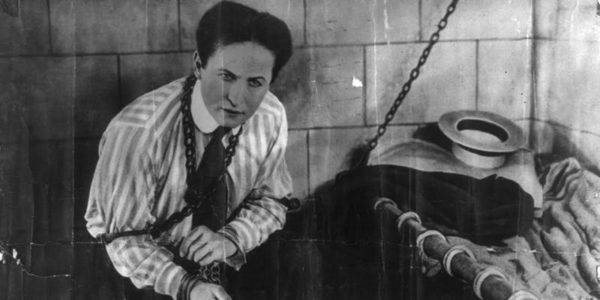
But why was Houdini so good at topology? Well, Houdini is famous for many daring escapes, from boxes, from milk churns, jail cells, handcuffs. You can buy a set of shackles here so you can do a spot of escapology yourself. (Note: Do not try this at home. Even more important, don’t try this inside a box at the bottom of the East River.) You can have a member of the audience, or a close personal friend, padlock your hands behind your back using two real padlocks, there is no trick here, they are real padlocks. And in one second you escape. How is this possible? With topology, of course. Should I give away the secret? I will give you a hint below.

I once tried escapology. When my legs were more bendy than they are now. Here is the true story of my escape from a holdall, filmed for national television in the United Kingdom. It has an unhappy ending, but not for the obvious reason.

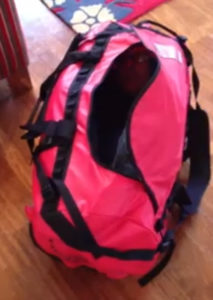
In 2010 we hear of the death of Gareth Williams, a mathematician working for UK GCHQ. He is found naked inside a red holdall, padlock on the outside, key on the inside. Because he worked for British “spies” people say that he must have been murdered.

There is an inquest and several experts say it is impossible for a man to get inside this type of bag, and close it so that the padlock is on the outside. They squeeze, they bend, they cannot do it.

At the time that the inquest results were announced I happened to be in my living room with a reporter friend. “I can do this!” I said to him immediately. I showed my friend the principle using that $20 Houdini shackle linked above. We then ran around London trying to find a red North Face holdall, the type in which Mr Williams was found. At last we found one in a shop in Kensington. (The shopkeeper said that a Sky News reporter bought one too just before, they must also know the trick. The race is on!)

We go to my flat and I try to get into the bag. It is very hard work. I am not as young as I used to be.

Look closely, you can see me in the bag.

But after 20 minutes I am in the bag and the bag is locked. The key is on the inside. The padlock on the outside. Exactly the condition in which Gareth Williams was found. It is very hot, and very difficult to breathe. And please note, my stomach is considerably bigger than Gareth Williams’, I have not exercised for 30 years, I was much older. I have dodgy shoulders. And because my friend is watching I still have my clothes on. But I did it.

I am locked in a bag.

The friend and I go to Channel 4 where he works. We tell the news people our discovery. They set up a camera. We are all ready. Health and safety documents signed. Three keys to the padlock are all outside the bag ready for them to open it. I do it again. Not quite so good this time. I slip a bit and the padlock is half in and half out of bag. But unfortunately the hole of the padlock is inside the bag and all keys are outside. I think this is funny. For a while. They slip the key into the bag and I open it. Channel 4 want me to try again. But I am too exhausted. So I end up on the cutting-room floor! (Another person tried the same trick a few weeks later, and got loads of publicity. She was a short teenager. She would have fitted inside a lunchbox.)

What can we learn from this? Experts, phooey! Mathematicians are experts, magicians are experts. Judges should speak to mathemagicians.

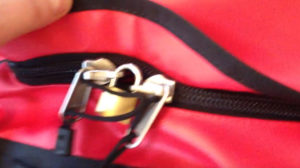
So what is the trick of topology? It is easy. First open the zip. Then bend bag/zip around until the two ends of the zip touch. The whole zip should form a large loop. Now put the padlock through the two pull tabs at the ends of the zip. So the padlock is on but the zip is still open. Now pull the two tabs together, making sure that the padlock is outside the bag as you do this. (Also have a key inside and another key outside, just in case. And maybe a strong knife and scissors.)

So what happened to poor Gareth Williams? Some say it was the Russians.  Me, I think he was experimenting, he was curious.

Mathemagical Thinking Lesson

In mathematics we have the concept of Proof by Existence. It’s probably the easiest type of proof to understand. Example: Prove that there is an integer solution of 

x^2-3x+2=0.

Prove it! That’s an easy one, try x=1. There, done!

Outside mathematics someone says something can’t be done, and then someone does it, that’s an existence proof. The proof doesn’t have to be constructive, i.e. we don’t need to know how it’s done, only that it has been done. “Houdini can’t escape from his water torture cell!” Well, he did. We don’t know how (or rather, we didn’t at the time), but we know a solution exists.

That’s were we sort of are with the Gareth Williams case. I say “sort of” because it wasn’t done under exam conditions, so to speak. So it’s reasonable to ask for another demonstration. And at least two people have done this while being observed. So it cannot be said that “This cannot be done.”

A book was published recently about the Gareth Williams case in which the author said he had tried “300 times” to get inside a holdall and lock himself inside. Therefore it cannot be done he said. I don’t think he mentions whether he has also tried to split the atom 300 times and failed.

This is all very annoying to the obsessive mathematician. The saying of maybe Carl Sagan, maybe Martin Rees, maybe William Wright, “Absence of evidence is not evidence of absence,” has clearly not caught on among the general public.

It’s also a very defeatist position to take. Only mathematicians, and not mathemagicians, should be allowed to say “It can’t be done,” and then only in relation to mathematics. If everyone said “It can’t be done,” we would all still be living in caves, and not on the way to Mars. Actually, language might not even exist, so we wouldn’t even be able to say “It can’t be done.” But that’s one for the philosophers.

A Trick With Dice

Ten is bigger than five, and five is bigger than one. And so ten is bigger than one. Basic stuff. In symbols (we mathematicians like symbols, more than we like numbers):

If A > B and B > C then A > C.             (*)

This is common sense. Wait, not so fast! (There is no such as thing as common sense to mathematicians.) This is not true for everything.

Do you play Rock, Paper, Scissors? Rock beats Scissors, Scissors beats Paper. In symbols

R > S > P

But it is not true that R > P. Because Paper beats Rock.

R > S > P > R > S > …

When something obeys (*), as numbers do, then we call that Transitive. But like Rock, Paper, Scissors there are many fun things that are not transitive, and some of them even involve numbers, in a way. And can even be used to win drinks at a bar. (This could turn into a theme.) Let’s see an example.

You play games with dice, then you are used to the standard dice with six sides, numbered 1, 2, 3, 4, 5, 6. Each side equally likely to be rolled. We are going to roll dice, you and I, to see who pays for the drinks. But we aren’t going to use regular dice. They will be six sided and they will be unbiased. But we are going to use six-sided dice with slightly different numbers on them. Here are three such dice:

A: 1, 1, 3, 5, 5, 6

B: 2, 3, 3, 4, 4, 5

C: 1, 2, 2, 4, 6, 6

We each choose a die, we roll. If we draw we roll again. Loser pays for the drink. All the dice are very similar, no? The pips on all the dice add up to 21, so the mean roll is 21/6 = 3 1/2, just like for a regular die.

I am feeling generous, I will let you choose your die first. You choose A? Ok, I choose C. Who wins most often? You’d think that would be equally likely to win because the means are the same, no? No! Look at table:

1 1 3 5 5 6
1 D D L L L L
2 W W L L L L
2 W W L L L L
4 W W W L L L
6 W W W W W D
6 W W W W W D

Along the top is your roll, die A. Down the left-hand side is my roll, die C. Thirty-six possibilities, out of which I win 17, you win 15, and there are four ties and we roll again. And this is true whichever die you choose. Choose B and I choose A, choose C and I choose B. Every time you pay for more drinks than me! Ok, so not a big advantage but it adds up over a typical lock-in session.

Warren Buffett is big fan of non-transitive dice. I don’t know if he is a big drinker.

Mathemagical Thinking Lesson

What can we learn from this? Other than don’t go to a bar with me. The most important lesson is that what happens on average does not give us the whole picture. All these dice have the same mean roll. That is irrelevant. What about other types of average? The median is the middle number in an ordered list. Die A has a median of 4, die B 3.5 and die C 3. Now there are differences, perhaps you’d choose die A. Doesn’t matter. Similarly the modes are different. The mode is the most frequent number, here all dice are bimodal, and are different. But again that form of average is irrelevant.

Normally we are great fans of common sense. But sometimes common sense can be highly misleading. Sometimes you have to ask questions that defy common sense.

See also the excellent essay by Stephen Jay Gould, “The Median Isn’t the Message,” https://journalofethics.ama-assn.org/article/median-isnt-message/2013-01

A Trick With Money

Everyone loves money! Everyone loves magic! Everyone loves mathematics!

Sadly not all of this is true. Actually most of it is not true. Imagine how difficult it must be for David and me to earn a living. Here is a trick we use in bars when people are very drunk. And we are desperate for cash.

We say to a drunk person, “Here are 20 coins, all showing heads. While I look away you turn over eight of them to show tails. I will keep looking away, you can even blindfold me, and I will divide the coins into two piles, each having the same number of tails face up. If I can’t do it you keep the 20 coins. If I can then you give me the same amount. Deal or no deal?”

How is this possible? How can we get two piles with same number of tails if we can’t see anything?

I will give the solution and then prove it is possible by algebra. Algebra is when you use letters instead of numbers. We’ll talk about symbols mathematics and numbers mathematics later.

But would you mind taking just a minute or two to have a go yourself? I know, I know. I also hate it when I’m asked in a book to spend a minute breathing deeply, or making a list of all the things I’d like to change about myself. But we aren’t going to do this often. Honest.

Ok, the solution. All you have to do to win the money from the drunk person is to move any eight of the coins to another pile, and turn all of them over. You will see that both piles have the same number of tails. Ok, it won’t be four in each pile, maybe that is what you expected. But I did not say that.

Here is the mathematical proof in a table. We don’t have to use 20 coins and turn over eight. Here we start with m coins and turn over n. When we move n into the new pile (on the right) x is the number of heads that get moved across, we don’t know what this number is but it doesn’t matter. See how the number of tails, coloured red, is the same on the left and the right. And it doesn’t depend on m or n.

LEFT PILE RIGHT PILE
Heads Tails Heads Tails
Initially m 0
Turn over n m-n n
Move n to another pile m-n-x n-(n-x) x n-x
Turn over right pile m-n-x n-(n-x) = x n-x x

Usual deal, if you do this in a bar and win then I get my 10% commission. If you mess it up and lose, I don’t pay you. It’s a bit like the performance-related pay in a hedge fund.

Mathemagical Thinking Lesson

This lesson is about thinking in different domains.

Did you figure out how to do trick? If you hadn’t then I wonder if it would have been easier if we’d used the numbers five and two instead? Or even two and one! What about 137 and 59?

With two and one, I think you would have got it. But then it wouldn’t have looked special, just dumb. With five and two you might have got the solution if you could be bothered. With 20 and eight we reckon you might have given up. That they are both even numbers and there are two piles might seem to be a clue, but is misleading. But then with 137 and 59 you might have thought there’s something special about those two numbers, maybe it’s all about prime numbers. Now there’s a garden path you wouldn’t want to be led along.

The mathematician has two ways to approach this.

The first method: Given the 20/eight version the mathematician might wonder if the numbers are special. If not, then they’d reduce the problem to the two/one version. Then move on to three/one, etc. Then 20/eight and finally the general solution, using letters instead of numbers.

The second method isn’t just for mathematicians, and is the way I approached it initially. We have four numbers to play with: Four (half of eight…there’ll be two piles); Six (half of 20-8); Eight; And 10 (half of twenty). (Twelve isn’t special, moving 12 is the same as moving eight.) And there’s one optional thing to do, turn coins over. There aren’t many experiments to go through. Moving four and turning them over is quickly shown to not work. And moving and turning eight works. Solution found.

We’ll talk about numbers people and symbols people later. There is a great advantage to being able to think in both domains. The mathemagician knows this, and knows how to distract either with the tedium of dealing with numbers or the fear of dealing with symbols.