Why Is Little Johnny Upset?

Little Johnny* started Grade 2 in the lower set of math. For the previous year, Little Johnny had been distracted by baseball, baseball cards, and more baseball, and hadn’t paid much attention in math class. But it was clear he was a smart kid, he was a whizz with batting averages, runs, etc. But his times tables, dividing 17 cookies between three friends, and suchlike? Not so much.

His parents were mathematicians. And his older siblings. Aunts and uncles? Yes, them too. Does math ability skip generations?

Mommy and daddy decided to take control. How do you get any seven-year old to study? Bribery! They would give Little Johnny even more baseball cards if he did some extra math at home.

This strategy paid dividends almost immediately. At the start of the next term of the year Little Johnny was promoted to the upper math set.

It was standard procedure to test all the children in math at the start of every new term. And so Little Johnny and all the other Grade 3 children sat the test. Little Johnny was confident. But then the results came out.

These days schools aren’t keen on giving out individual scores to each child. That would be so…Victorian. We don’t want the children getting upset. Nevertheless Little Johnny did get upset. And that’s because the teachers told everyone the average scores for the two sets. And although the upper set did better than the lower set, as you’d expect, the average for both sets fell compared with the previous term’s results. And the only difference between the two terms was that Little Johnny had been promoted. It was all his fault.

There’s something initially odd about this until you look into it all a bit deeper. Even then, it’s still odd. So you need to go deeper still.

How could both averages fall? Well, it depends on how Little Johnny’s scores compared with the rest of his classes. If he was in the bottom of the lower set then removing him from the average would be beneficial to the class’s average. But he was the best in the lower set so removing him made the average of the remaining pupils fall. When he joined the smarter kids, he was (for now) probably the lowest scoring out of all of them. So again, the average for the upper set also fell. You can see how both classes might be a bit miffed. (Just a thought, but maybe the Victorians knew something about education after all.)

It all makes sense.

Except that surely the average of the two averages shouldn’t change? It’s the same pupils for the two terms so if their scores don’t change and you are simply moving one number from one set to another it won’t change the average over all of them. So if one average goes up, the other average must come down so that the average across all pupils stays the same.

No, I thought we had it cracked but it appears not.

Until we do the calculations with some numbers.

And to keep it really simple we will have two students in the lower class, one of them being Little Johnny, and one in the upper.

These are their test scores: In the lower set, 10 and 20 (that’s Little Johnny). In the upper set, 30.

The lower set has an average of 15, and the upper, rather trivially, 30. Now move Little Johnny and his score to the upper set. Now the average in the lowet set is 10, the score for the sole remaining pupil. And the average in the upper is 25. The lower average has fallen from 15 to 10, and the upper from 30 to 25. Both averages have fallen.

Let’s see what has happened. It’s all about the weighting, how many numbers there are in each average. The average across all three students is (10 + 20 + 30) / 3 = 20. You get the same average if you take 2 x 15 + 1 x 30 =60 and divide by 3, because there are two students in the lower set initially. And you get the same when you take 1 x 10 + 2 x 25 = 60 and divide by 3. Because in the second term there’s only one student in the lower class but two in the upper.

Little Johnny is doing so well in his math now, he almost understood why both averages fell. Next year they’ll have to start a new upper upper set just for him!

* Not his real name.

Photograph by Eric Tompkins on Unsplash.

A Jug of Gin, A Leg of Racehorse—and Thou

Recent Cambridge University research, published in the journal Philosophy and Technology, warns about the dangers of machine learning. The below is taken from the Daily Telegraph.

Artificially intelligent recruitment programmes are discriminating against people who wear glasses or sit in front of bare walls, academics have warned, as they urged companies to stop relying on pseudoscientific software.

In video interviews, AI programmes tended to favour people sitting in front of bookshelves or with art on their walls. They also recommended applicants wearing head scarfs, believing them less neurotic, while judging people who wore glasses as less conscientious.

The team said using AI to judge personality was automated pseudoscience reminiscent of physiognomy or phrenology- the discredited beliefs that character can be deduced from facial features and skull shape.

We are concerned that some vendors are wrapping snake oil products in a shiny package and selling them to unsuspecting customers, said co-author Dr Eleanor Drage.

Pseudoscientific?! Someone once said to treat every obstacle as an opportunity. So here goes.

Probability, statistics, risk and return? Yawn! Artificial intelligence? LLM, self-organizing maps,…Yeah, baby!

IBM, M&S, Walmart stocks? Booooring! Alternative investments? Crypto, wine,…Coooooool!

Scenario: You have ambitions to be a hedge fund manager. But the competition for investment money is stiff. You might have some programming skills and a LinkedIn profile. What more do you need? You need a gimmick, to make you stand out from the riff-raff.

Solution: Artificial intelligence for alternative investments…AI for AI…it would be a crime not to! That’s our gimmick. Let’s do the math.

Here are the sectors for the (boring) classical investments: Energy, Real Estate, Financials, IT, Materials, Healthcare, Industrials, Consumer Staples, Utilities, Consumer Discretionary, Communication Services.

Let’s get creative with some less, ahem, traditional investments. I’m going to include a few fairly standard investments, but then I’m going to let rip. In increasing order of weirdness: Sterling, Gold, Oil, Coffee, Bitcoin, UK houses, Wine, Racehorses, Diamonds, Online advertising, Rolex Submariner watches, Gin, Chocolate bars, Crime in Chicago.

No, your eyes aren’t playing tricks on you, I’ve included gin, chocolate, diamonds. And crime. Does it pay? Let’s see.

I downloaded data for all of the classical sectors and the alternatives. Getting data for the alternatives was tricky to say the least. But, hey, that’s not an obstacle, it’s an opportunity! No other potential hedge fund manager is going to be looking at the same data as us!

For example, for racehorses I got data from Statista for the sale prices of racehorses in Ireland. I know from personal experience that the sale price of a racehorse does not capture the realities of investing in them. The costs of ownership are staggering. But, hey ho. Data for Rolex Submariner watches from Googletrends. Simply interest shown in this particular watch. Not in the slightest bit financial. Crime in Chicago, ok, I couldn’t resist. Is there still any link between crime in Chicago and the liquor trade, or was that link broken almost a century ago? Data from the City of Chicago website. The data is not financial, simply quantity of crimes each year. No allowance for quality.

I converted all data into US dollars, that was more art than science. And looked at annual returns over ten years. I then applied a wonderful machine-learning method called self-organizing maps (SOM).

SOM is an unsupervised-learning method that groups together data points using distance between the feature vectors (here the returns). The data points are then mapped onto a two-dimensional grid, think chessboard, so we can visualize which data points/feature vectors have similar characteristics. Or think moving similar people to the same table at a wedding. And the closer the tables the more similar the people at those tables will be. Tables far apart are very dissimilar, the aunts and uncles no one talks about, or to. (One way that the wedding-table analogy falls down is that at weddings there are usually the same number of people at each table. In SOM some tables are more popular than others.)

And this is what I found.

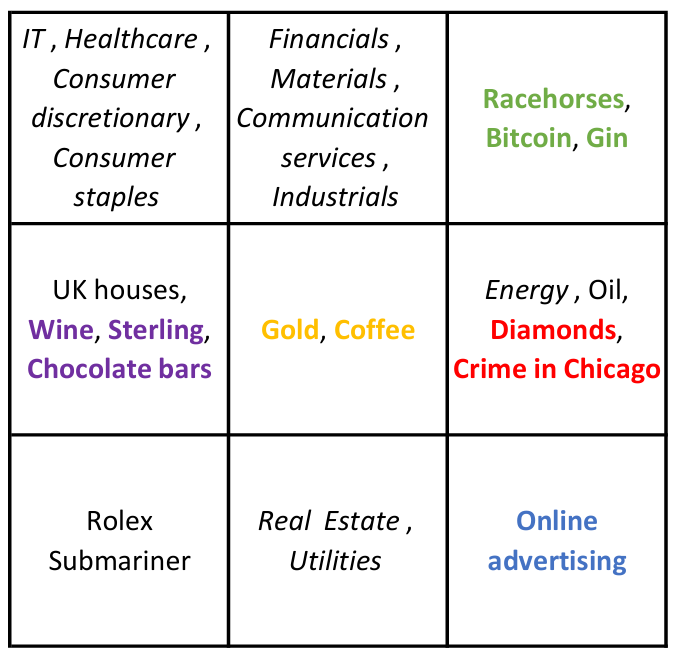
Each cell represents ‘investments’ that are similar. So IT, Healthcare, etc. are similar to each other and very different to racehorses and gin. No kidding. By spreading money across the nine categories we increase diversification and so reduce risk. So some IT shares, a financial or two, a racehorse, definitely plenty of gin, some diamonds (maybe pass on the crime), and so on.

This is then the information that goes into our pitch for raising money for our hedge fund. “Our fund is unique in applying cutting-edge artificial intelligence to portfolios of alternative investments. By exploiting the non-linear blah blah maximization blah blah we construct portfolios to optimize diversity and so blah blah.” Irresistable to those allocating money to new funds. (And if we get comped watches, fine wines, diamonds, and a racehorse leg or two, well, so be it.)

And the point of this exercise?

The beauty of machine learning is that it is fun to do. Usually very easy, there is always some Python code you can use. The hardest part of putting together a pitch like this is in finding the data in the first place, and choosing the best typeface for the pitchbook.

You also always get an answer. With classical mathematical modelling, you might spend months or years perfecting your model, only to find a flaw and have to throw it all away. But not having a clue what the algorithm is doing inside its black box means you might not find out that there is a major problem until after you’ve lost all of your investors’ money.

But not knowing what is inside the box is not a bad thing. If you can’t see it, then nor can your investors. Remember, these aren’t obstacles, they are opportunities.


Disclaimer: This information is for general informational purposes only and does not constitute financial, legal, or tax advice. It is not intended to be a substitute for professional advice. You should consult with a qualified professional before making any financial decisions. Past performance is not indicative of future results. The information provided is not an offer to sell or a solicitation of an offer to buy any securities or other financial instruments. We are not responsible for any losses or damages that may arise from your reliance on this information. I hope all that is obvious.

Photo by Magdalena Smolnicka on Unsplash


It’s A Conspiracy I Tell You!

I don’t believe in conspiracy theories but — whenever you hear the “but” you know exactly what is coming! — there is one story that is rather worrisome, and also something to which one can trivially add a bit of mathematics as a convincer.

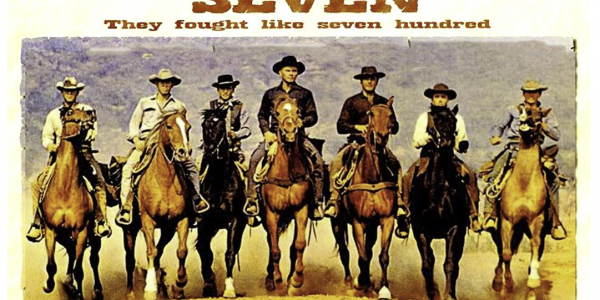
Did you know that the actors in The Magnificent Seven died in real life in the order in which they died in the movie?

To remind you the seven were, as copied from Wikipedia,

  • Yul Brynner as Chris Adams, a Cajun gunslinger, leader of the seven
  • Steve McQueen as Vin Tanner, the drifter
  • Charles Bronson as Bernardo O’Reilly, the professional in need of money
  • Robert Vaughn as Lee, the traumatized veteran
  • Brad Dexter as Harry Luck, the fortune seeker
  • James Coburn as Britt, the knife expert
  • Horst Buchholz as Chico, the young, hot-blooded shootist

You don’t have to take my word for it, it’s easy to google.

I remember discussing this over dinner at a training course in Mexico City. We even got as far as looking at the probability of this happening. How can you order seven people? For the first one there are seven to choose from. For the second there are six remaining. Then five, and so on. This means that the probability of this being a coincidence is one in 7! (that’s seven factorial), i.e. about 0.02%.

Can you explain this any better than chance?

Maybe they died in the movie according to their ages. You could check that out. That would make some sense, the older gunfighters die sooner in the film, and the older actors die earlier in real life.

We could probably quite easily quantify this effect, to increase that 0.02%. But it’s hard to get the probability up to anything remotely probable.

This is the way the dinner conversation went.

One matter that was not discussed, perhaps out of politeness since I was the teacher and they were the students, was that maybe I WAS MAKING IT UP ON THE SPOT, YOU MUPPETS!

My apologies. This conspiracy theory, like all of them, has no basis in fact. But it was fun while it lasted. My mathemagical distractions, the statistical analyses, trying to find rational explanations, all served to convince my audience that there must have been a plot! I should have got an Oscar for my performance!!

Simplify!

The following may or may not be factually accurate. It all happened a long time ago. But it is absolutely 100% correct in spirit.

Twenty or so years ago I was browsing through the library of Imperial College, London, when I happened upon a book called something like The Treasury’s Model of the UK Economy. It was about one inch thick and full of difference equations. Seven hundred and seventy of them, one for each of 770 incredibly important economic variables. There was an equation for the rate of inflation, one for the dollar-sterling exchange rate, others for each of the short-term and long-term interest rates, there was the price of fish, etc. etc. (The last one I made up. I hope.) Could that be a good model with reliable forecasts?

[Hint: How good are economic forecasts generally?]

Consider how many parameters must be needed in such a model, every one impossible to measure accurately, every one unstable. I can’t remember whether these were linear or non-linear difference equations, but every undergrad mathematician knows that you can get chaos with a single non-linear difference equation so think of the output you might get from 770.

Putting myself in the mind of the Treasury economists I think “Hmm, maybe the results of the model are so bad that we need an extra variable. Yes, that’s it, if we can find the 771st equation then the model will finally be perfect.”

No, gentlemen of the Treasury, that is not right. What you want to do is throw away all but the half dozen most important equations and then accept the inevitable, that the results won’t be perfect.

A short distance away on the same shelf was the model of the Venezuelan economy. This was a much thinner book with a mere 160 equations. Again I can imagine the Venezuelan economists saying to each other, “Amigos, one day we too will have as many equations as those British cabrones, no?” No, what you want to do is strip down the 160 equations you’ve got to the most important. In Venezuela maybe it’s just a few equations, for the price of oil, inflation, and maybe how much it costs to buy a politician.

We don’t need more complex economics models. Nor do we need that fourteenth stochastic variable in finance. We need simplicity and robustness. We need to accept that the models of human behaviour will never be perfect. We need to accept all that, and then build in a nice safety margin in our forecasts, prices and measures of risk.

Perspective

I love watching Dragons’ Den, the programme in which entrepreneurs try to get established business people to invest in their ideas. I love trying to predict which Dragon will say what, how they will negotiate a deal, how they compete with each other to make themselves look good against other Dragons. I love shouting at the TV, “What about patents and intellectual property?” before the Dragons. And I particularly love it when they so obviously get it wrong. Trunki? Come on, just because a bit of plastic broke on a prototype you aren’t going to invest in such an obvious hit? And I find it reassuring when they break all their own rules to invest in something they get emotionally attached to. E.g. Reggae Reggae Sauce. Although I’m sure it is deliciously invigorating many of the facts and figures that the entrepreneur gave turned out to be wrong, many of them during the programme itself.

But I hate it when an entrepreneur gets flummoxed by a Dragon negotiating for a better deal. An entrepreneur will open with offering 10% in return for a certain investment. A Dragon might find this too little and counter with 20%. At which point the entrepreneur shakes his or head and declines.

What are they thinking?

It looks to me like they are thinking from the perspective of the Dragon. I’m going to double his money? Double! No way!

But this is completely the wrong way to look at this. They should look at it from their own perspective initially. So I’m going down from 90% to 80%. No biggie. And then they can put themselves in the shoes of the Dragon. Ok, I can see that doubling the shareholding might double the help the Dragon will give. Which will make that 11.11% reduction in their shareholding (10/90) look pretty insignificant.

Rule #1 Of Investing: Don’t Obey Rule #1

One of the first lessons in any course on investing will be about portfolio construction and the benefits of diversification, how to maximize expected return for a given level of risk. If assets are not correlated then as you add more and more of them to your portfolio you can maintain a decent expected return and reduce your risk. Colloquially, we say don’t put all your eggs into one basket.

Of course, that’s only theory. In practice there are many reasons why things don’t work out so nicely. Often that’s because stocks and other investments stubbornly refuse to do what they are told.

But can it ever be optimal to not even try to diversify? Should you ever do the exact opposite of Rule #1? You betcha.

As we’ll see people in banks and hedge funds are encouraged to not diversify, to instead concentrate risk. I don’t know whether this is explicit or instinctive.

Imagine the following scenario. It’s your first day as a trader at an investment bank. You’ve had a world-class university education in economics in, say, Chicago. There you learned about all kinds of theoretically marvellous trades and how to manage risk by diversifying.

You are being introduced to the rest of the trading team. You notice that all of the trades they are doing are strangely similar. It worries you a bit because it doesn’t look like they are diversifying much.

You are then shown your desk, with multiple screens, and told to start trading.

Being a decent person you naturally want to do the best for your bank and so you seek out some trades that are uncorrelated to those of your colleagues but which also have a high probability of success.

Let’s put some numbers to this. There are dozens of other traders all making the same trade, and this trade has a 50:50 chance of making or losing a large amount. You have a better, and independent, trade that has a 75% chance of doubling your money and 25% of losing it all.

What happens next?

There’s a 50% chance that all the other traders lose a vast amount of money. This is not great. They might lose their jobs. The bank might go under.

But there’s also a 50% chance that they’ll be heroes, and rewarded as such in bonuses.

Meanwhile your trade might make some money. More likely than the other traders, at 75%. So you are more likely to be a hero too. No! If the others lose and you win then you are too tiny to even be noticed. You won’t be able to save the bank. And certainly don’t expect a bonus.

You can see this in the following table. If the other traders lose then everyone is fired including you. You can only get a bonus if the traders and you both win, and that has a probability of 0.75 x 0.5 = 37.5%.

  Traders win (50%) Traders Lose (50%)
You win (75%) Bonuses all around!!! (37.5%) All fired!!! (37.5%)
You lose (25%) You are fired, other traders get bonuses (12.5%) All fired!!! (12.5%)

No, the only way to get that bonus is to cling to the coattails of the other traders. Do the same trade as them and you have a larger 50% chance of that bonus.

Lose money when all around are making it, you’re fired. Make money when all around are losing it? Expect a big bonus? No way! Your profits will help to bail everyone else out and no one gets a bonus, even you. No, you should do the same as everyone else.

As Keynes said, “It is better to fail conventionally than to succeed unconventionally.”

Cheers!

Now we are going to talk about drink. About time.

Specifically the martini.

The original classic martini cocktail is two thirds gin, one third dry vermouth shaken with ice (if you are James Bond) or stirred (for Somerset Maugham). The ratio of vermouth to gin has decreased over the years, reaching a lower limit with Noel Coward, “A perfect martini should be made by filling a glass with gin, then waving it in the general direction of Italy.”

You can use vodka instead of gin in a vodka martini. Or both, as favoured by Bond, who also specified Lillet instead of vermouth. Lillet isn’t technically a vermouth. Although it is also a fortified wine only vermouth contains wormwood.

To confuse matters there is a brand of vermouth called Martini. This may or may not have been the source of the lower-initial-cap cocktail’s name.

I’m thirsty.

Before getting too carried away (from under the table?) let’s look at some of the mathematics of the martini.

It is the best of drinks and the worst of drinks.

The best is clear. But why the worst? It is because it is so depressing drinking one. Not because of the depressive effects of alcohol but because of the shape of the glass. I shall explain. But first a question.

The classic martini glass is cone shaped. Suppose you have a generous bartender who fills your glass to the brim. You sip. Before you know it the martini is half way down the glass. How much drink is then left?

This is where you get to think like a mathematician. Although that is rarely so depressing as here.

The martini glass is a cone. To mathematicians the cone is a three-dimensional (although this can be generalised) body having a horizontal cross section that is the same shape at any position and where the size, say diameter, of that shape increases linearly with the height of the cross section. We think of the cone having circular cross sections. But that need not be the case. The Egyptian pyramids are also cones.

The bottom half, or any fraction, of the martini glass is therefore the same shape, technically “similar,” to the whole martini glass. This wouldn’t be true of, say, a champagne flute. The bottom of the flute is flattish, but higher up the sides are steep. The sides of the martini glass are always the same angle from bottom to the rim. And it doesn’t matter what that angle is, as long as it’s the same all the way up.

This means that the relationship between the volume of the liquid and its depth is very simple. You just take the fraction of the height of the level of the liquid to the depth of the original and then raise that to the power of three. Why three? Because we are working in three dimensions.

This means that if we are already (so soon?) half way down then the remaining volume is one eighth of what we started with.

You see why that is depressing. Most people when asked about this will say something like, oh there’s about one third left. But, no, it’s far worse than that.

I hope I haven’t spoiled your drink. Don’t be like me. As I see the level falling I am continually in advance thinking about how little is left. No wonder I have to order a second.

Oh, and avoid olives, they make the mathematics even more depressing, large olives, less alcohol.

A short poem to end.

“I like to have a martini

Two at the very most

After three I’m under the table

After four, I’m under my host.”

Dorothy Parker

There’s Nothing Better Than The Right Bad News!

There are many quotes by famous people about problems being opportunities.

The block of granite which was an obstacle in the pathway of the weak, became a stepping-stone in the pathway of the strong.” Thomas Carlyle.

Every problem is an opportunity in disguise.” John Adams.

Never let a good crisis go to waste.” Attributed to many.

All sensible and inspirational twists on setback.

We are going to apply a similar twist to rather gross facts. And in so doing highlight how mathematics can be used to frighten the unsuspecting.

Did you know that one in six mobile phones are contaminated with faecal matter? And cell phones carry ten times as many bacteria as toilet seats? Forty percent of office coffee mugs contain coliform bacteria, found in faeces. Forty percent! It gets worse. It is estimated that there is faecal matter on 72% of shopping carts. And shoes? Don’t go there.

Boy, how those numbers frighten us!

And those numbers also sell cleaning products. (Oh, sponges are about the most contaminated things there are.) And newspapers and magazines.

But we are looking at those numbers the wrong way. It’s the old problem/opportunity thing in disguise.

Have you used your cell phone today? Yes. Had a coffee in an office mug? Indeed. Worn shoes perhaps? Check. And are you currently ill? Me neither.

What’s the correct conclusion from the data then?

In the famous words of Corporal Jones, “Don’t panic!” As long as people’s health doesn’t get any worse then generally speaking the more germs there are the better. It simply mean that those germs aren’t as bad as their PR makes out.

The Wealth Manager

Following on from Credit Ratings, here’s a true story about how reassuring mathematical analysis can be. Until it turns out to be baloney. This story is also a warning about experts. Unfortunately, although there’s a lesson here we aren’t sure what it is. Sometimes you get screwed no matter how smart you are. Maybe that’s the lesson.

For Paul, 2007 had been a good year financially. His businesses, based around financial mathematics, publishing and training, were starting to take off. Being self employed his earnings were paid without any tax having been withheld. This meant he had to keep a regular check on how much he owed the UK’s Inland Revenue and, not wanting to end up behind bars like some tax-dodging TV evangelist, put it aside for later payment.

Paul is financially very conservative, he wanted to put this money somewhere incredibly safe, but he’s also a bit of a worrier. He knew that the complex financial instruments he worked with were poorly understood, and that their risk management was even worse. He knew that people in banks were confused about fundamental financial principles, and worse, that they didn’t know that they were confused. He knew that it’s important that the incentives of employees (the bankers) and the benefits of the owners and creditors (the man on the street) be lined up, and that in practice they rarely were. And long before it became fashionable he would tell anyone who would listen that the cleverest of the bankers didn’t know what they were doing.

Paul decided to speak to his Wealth Manager at his bank, B______s, to see if there was anywhere safe that he could leave it for a few months before paying the taxman. This was now the second half of 2008. The investment firm Bear Stearns had bitten the dust earlier in the year. So prudence had been the word of the days for several months now.

Paul mentioned these concerns to his Wealth Manager. And the Wealth Manager made some recommendations. One thing that Paul knew about was the Financial Services Compensation Scheme (FSCS), the UK’s version of the US’s Federal Deposit Insurance Corporation, which would at that time cover up to £50,000 in the event of a collapse. Well, the money that Paul owed Alistair Darling, the then Chancellor of the Exchequer, was quite a bit more than this. However, he also knew that there was a version of the financial guarantee that applied to insurance companies where the cover was 90% of any money lost, with no limit. Paul had done his research. So when the Wealth Manager mentioned that he had a couple of insurance-company products to offer, Paul naturally was keen.

There were two products on offer. They both had interest rates of about 4% annualized. One had a slightly higher return than the other. But the return wasn’t the point. The point of this exercise, remember, was to protect the money that he was holding onto on behalf of the Inland Revenue. The Wealth Manager gave the sales pitch for these two products. They seemed very simple, very “vanilla” in the financial jargon, basic short-term bonds. Credit ratings were mentioned and Paul does recall his sense that one of these investments was very, very, very safe, while the other was a mere very, very. The latter had the slightly higher rate of return. The greater the risk, the greater the expected return. That’s classics portfolio theory.

The conservative Paul opted for the lower return, thrice-very-safe investment. The government’s tax money, or at least 90% of it, was now secure.

This was a Thursday in September 2008.

That weekend brought the news of the collapse of Lehman Brothers and the near bankruptcy of AIG due to trading in complex credit derivatives, the very same instruments and models that Paul had said in 2006 “fill me with some nervousness and concern for the future of the global financial markets.”

Did we mention that it was an AIG insurance bond that Paul had bought?

Paul spoke to his Wealth Manager who reassured him that “there was nothing to worry about,” and that they “were speaking to AIG at the highest possible level.” This gave Paul a warm glow, he felt special. It was nice having a Wealth Manager. “Whatever happens to AIG, the money will be returned in 24 hours,” they said.

The next day the money had not reappeared, and B______s were now saying “48 hours” for the return. There was still nothing to worry about because insurance products come with a cooling-off period of 14 days.

Over the next few days the language of the Wealth Manager changed subtly, mention of cooling-off periods disappeared and timescales became more fluid. And suddenly there was talk of early-redemption penalties. This certainly didn’t fit in with the promise of a full refund in the first 14 days. Meanwhile AIG wasn’t getting any better.

Paul decided to take what little control he could, and started to make his own enquiries. He called AIG. To his surprise, considering their situation, the call was answered promptly, and he was put through to someone dealing with these bonds. Paul’s question was simple: “Was there or was there not a cooling-off period?” The AIG person did not know. She read out the bond’s particulars, the same paperwork that Paul had in front of him during the call. No mention was made in the paperwork of cooling-off periods or early redemption.

Paul called the Financial Services Authority, the then regulating body. He was going to ask about specifics of his bond and was expecting a response such as “Go to the FSA website, type in the company name, look for your bond in the dropdown menu, and the details will appear in a pop-up window.” It was the 21st century after all. Unfortunately the FSA’s representative said something somewhat different, in a very tired voice, something rather like “Do you know how many companies there are? Quite frankly, we don’t know who we regulate.” This was not looking promising.

Paul then went to the FSCS’s website. In the event of AIG collapsing they would be the ones to pick up the tab. Although they seemed very proud of their record in recompensing clients of failed institutions it was clear that they had never had to deal with anyone quite the size of AIG, a top-20 global company which sponsored Manchester United football team and, it seemed, much of the rest of the economy. (Forbes ranked them the 18th largest company in the world in 2008. “I bought one of your insurance bonds and all I got was this lousy Man United t-shirt.”) The case studies on the FSCS’s website were all firms that you’d never have heard of. Oh dear. It was now clear to Paul that he couldn’t depend on the insurance bond’s insurance.

Fortunately, this story has a reasonably happy ending – after a number of weeks nearly all the money was returned. Paul was in fact probably one of the more fortunate purchasers of this product. The BBC television journalist Jeremy Clarkson, who found himself in a similar situation (but with only the “very, very” safe AIG bond instead), said “I made strenuous efforts to get my money out of AIG as soon as the scale of its problems became apparent. But it wasn’t possible. Inwardly I was screaming. It’s my money. I gave it to you. You’ve squandered it on a Mexican’s house in San Diego and a stupid football team and that’s your problem. Not mine.” (Clarkson and Mexico have some history, but his observation had some truth to it, many mortgage brokers targeted specific racial groups for their sub-prime, teaser-rate, AIG-insured mortgages.)

But this was not a problem just for isolated investors. AIG was a major node in the financial system, and as its tangled web fell apart many companies, indeed entire countries, were severely affected by the ensuing economic mayhem. People lost their jobs, their homes, their life savings, even their lives (financial crises are strongly correlated with health crises and suicides).

Now, as tales from the credit crunch go this is not exactly movie material – it’s more the Big Short in reverse, not an attempt to make a killing from a crisis, but an attempt to save money to pay tax – but it does prove a point: We are only human, gullible, fallible, and despite our best efforts as prone as anyone to getting things wrong.

This brush with a failing, flailing insurance giant also taught Paul things he didn’t know, and reinforced a few that he did.

• Banks don’t know what they are talking about. They speak in jargon, much of which they don’t understand. But since there is no down side for them it doesn’t matter. To some extent you just have to hope for the best. Experts? Phooey!

• Regulators are clueless.

• Guarantees mean nothing. The FSCS paid out an average of £200million a year between 2001 and 2006. Between 2006 and 2011 that rose to an average of £5billion per annum, and they had to take out a loan from the Bank of England. But AIG was bailed out to the tune of $85billion. The numbers just don’t add up.

• Bailouts can be necessary, but only because some companies are so humungous in size. In some Darwinian sense entities should be allowed to collapse. But AIG was too big, its influence was everywhere. How many people had insurance through AIG? Just take car insurance, for example. How many cars would have been left uninsured, what repercussions would that have had? It’s impossible to tell.

• Being a mathematician doesn’t make you immune to the financial system’s occasional paroxysms – which is bad news because the system is effectively run by quants.

You could say that Paul should have been more careful. But that was precisely his goal. At some stage he had to take a chance on the advice he was given. And we know that that is risky. The alternative is to research and research and research, leaving no stone unturned … but the end result would be what? To not invest in anything? To not put your money in the bank even? Put it in government bonds? Invest it all in gold, or in property? Put it under the mattress? There’s no middle ground where absolute safety and trust overlap. But perhaps this new world in which there is no financial security – where a banknote, a cheque, a bond, a share certificate, can suddenly become irrelevant – is more natural. Perhaps the few decades in which banks were apparently safe was the anomaly, that a return to the precarious state that has been the norm throughout history, and still is in many countries, was inevitable.

Credit Ratings

Didn’t you feel proud when your teacher gave you an A+ at school? Or were you a C student, must try harder? Don’t tell us you were an F! My, you’ve done well…considering.

Just as teachers grade their students so there are businesses who grade investments. The three main credit rating agencies are Moody’s Investors Service, Standard & Poor’s and Fitch Ratings. Such agencies analyse the creditworthiness of companies, and their likelihood of going bust, as well as the risks in individual financial instruments. And they rate countries too.

Let’s take Moody’s for example. Their ratings start at the top, with the rating Aaa, “The highest quality and lowest credit risk” and “Best ability to repay short-term debt.” Below, and a smidgen riskier, comes Aa1, then Aa2, Aa3, followed by A1, A2 and A3. These are still supposedly low credit risk. We move even lower to the Bs with Baa1, Baa2, Baa3, then Ba1, and so on. All of these are higher risk with some “speculative elements.” By B1, B2 and B3 we are in high credit-risk territory. Finally come the Cs, the lowest of which is C itself “Rated as the lowest quality, usually in default and low likelihood of recovering principal or interest.”

Baa3 and above the instruments are supposedly “Investment grade.” Ba and below are non investment grade, also known as “junk.”

Good idea, no? And very helpful to investors. Knowing how professional bodies perceive risk in these companies and products can help investors make qualitative judgements about what to add to or subtract from their portfolios. But there’s more, there’s a quantitative angle to this as well. Let’s take as an example a bond rated Ba2. This bond has a price in the market. Suppose it yields 3% per annum. And suppose bank, i.e. risk-free, interest rates are 2%. Then (under lots of assumptions) these numbers can be interpreted as there being a 3-2=1% probability of the company defaulting on that bond in a year. (That’s 99% chance of getting one dollar and two cents back for your one-dollar investment, and 1% chance of nada.) Now we are in the realms of mathematics and can make quantitative judgements about whether Ba2 bonds are too risky, or which specific bonds to buy.

There are problems with this, or we wouldn’t be writing about this topic.

The first problem is the concept of quantifying probability of default. As a rule bankruptcy is a one-off event from which one doesn’t recover in the same form as before the bankruptcy. And as such a company only experiences this once. Therefore there’s not that much in the way of statistics for individual companies, only statistics about types of companies or companies with the same credit rating. There are parallels with health and death. Death is also a one-off event, at time of writing, and anyone who tells your life expectancy is basing that on tables of life expectancies of people with the same credit health rating as you, whether you smoke or not, take part in dangerous sports, etc. The mathematics of death and bankruptcy are very similar. More about life and death later.

But there’s a bigger problem. It concerns who pays for the credit rating. And it’s not who you’d expect. The credit rating on company XYZ is typically paid for by…company XYZ.

They need the rating to be taken as a serious investment, and they want it to be as high a rating as possible. The rating agency want their business and a happy customer. It doesn’t take a genius to figure out that their two interests are aligned. Had they been business partners then having perfectly aligned interests is exactly right. But here the rating agency is supposed to be acting as an unbiased middleman between the investor and the investment.

A third problem related to the above is that having competition among rating agencies might lead to companies choosing to work with those agencies that are the softest, who give the highest rating. None of this is helped by the lack of transparency about the rating process itself.

This is moral hazard.

Never mind all those problems. The main thing is that mathematics is involved. So it must be ok.