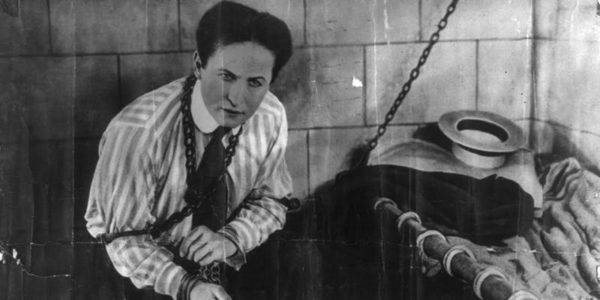
Little known fact – in which we specialize – Houdini could have been a great mathematician. Specifically a topologist. Escapology, topology, there are great similarities. Topology is the mathematical study of shapes and spaces. I don’t know much about it. It seems to involve eating a lot of donuts. Or knitting. (But, have you noticed, there’s never a topologist to be found when it’s time to untangle the Christmas tree lights.)
But why was Houdini so good at topology? Well, Houdini is famous for many daring escapes, from boxes, from milk churns, jail cells, handcuffs. You can buy a set of shackles here so you can do a spot of escapology yourself. (Note: Do not try this at home. Even more important, don’t try this inside a box at the bottom of the East River.) You can have a member of the audience, or a close personal friend, padlock your hands behind your back using two real padlocks, there is no trick here, they are real padlocks. And in one second you escape. How is this possible? With topology, of course. Should I give away the secret? I will give you a hint below.
I once tried escapology. When my legs were more bendy than they are now. Here is the true story of my escape from a holdall, filmed for national television in the United Kingdom. It has an unhappy ending, but not for the obvious reason.
In 2010 we hear of the death of Gareth Williams, a mathematician working for UK GCHQ. He is found naked inside a red holdall, padlock on the outside, key on the inside. Because he worked for British “spies” people say that he must have been murdered.
There is an inquest and several experts say it is impossible for a man to get inside this type of bag, and close it so that the padlock is on the outside. They squeeze, they bend, they cannot do it.
At the time that the inquest results were announced I happened to be in my living room with a reporter friend. “I can do this!” I said to him immediately. I showed my friend the principle using that $20 Houdini shackle linked above. We then ran around London trying to find a red North Face holdall, the type in which Mr Williams was found. At last we found one in a shop in Kensington. (The shopkeeper said that a Sky News reporter bought one too just before, they must also know the trick. The race is on!)
We go to my flat and I try to get into the bag. It is very hard work. I am not as young as I used to be.
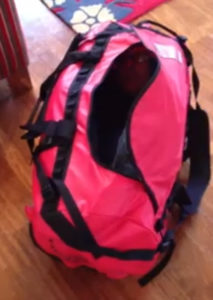 Look closely, you can see me in the bag.
But after 20 minutes I am in the bag and the bag is locked. The key is on the inside. The padlock on the outside. Exactly the condition in which Gareth Williams was found. It is very hot, and very difficult to breathe. And please note, my stomach is considerably bigger than Gareth Williams’, I have not exercised for 30 years, I was much older. I have dodgy shoulders. And because my friend is watching I still have my clothes on. But I did it.
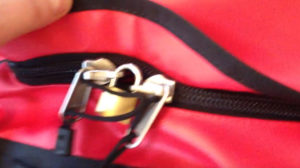
I am locked in a bag.
The friend and I go to Channel 4 where he works. We tell the news people our discovery. They set up a camera. We are all ready. Health and safety documents signed. Three keys to the padlock are all outside the bag ready for them to open it. I do it again. Not quite so good this time. I slip a bit and the padlock is half in and half out of bag. But unfortunately the hole of the padlock is inside the bag and all keys are outside. I think this is funny. For a while. They slip the key into the bag and I open it. Channel 4 want me to try again. But I am too exhausted. So I end up on the cutting-room floor! (Another person tried the same trick a few weeks later, and got loads of publicity. She was a short teenager. She would have fitted inside a lunchbox.)
What can we learn from this? Experts, phooey! Mathematicians are experts, magicians are experts. Judges should speak to mathemagicians.
So what is the trick of topology? It is easy. First open the zip. Then bend bag/zip around until the two ends of the zip touch. The whole zip should form a large loop. Now put the padlock through the two pull tabs at the ends of the zip. So the padlock is on but the zip is still open. Now pull the two tabs together, making sure that the padlock is outside the bag as you do this. (Also have a key inside and another key outside, just in case. And maybe a strong knife and scissors.)
So what happened to poor Gareth Williams? Some say it was the Russians. Me, I think he was experimenting, he was curious.
Mathemagical Thinking Lesson
In mathematics we have the concept of Proof by Existence. It’s probably the easiest type of proof to understand. Example: Prove that there is an integer solution of
x^2-3x+2=0.
Prove it! That’s an easy one, try x=1. There, done!
Outside mathematics someone says something can’t be done, and then someone does it, that’s an existence proof. The proof doesn’t have to be constructive, i.e. we don’t need to know how it’s done, only that it has been done. “Houdini can’t escape from his water torture cell!” Well, he did. We don’t know how (or rather, we didn’t at the time), but we know a solution exists.
That’s were we sort of are with the Gareth Williams case. I say “sort of” because it wasn’t done under exam conditions, so to speak. So it’s reasonable to ask for another demonstration. And at least two people have done this while being observed. So it cannot be said that “This cannot be done.”
A book was published recently about the Gareth Williams case in which the author said he had tried “300 times” to get inside a holdall and lock himself inside. Therefore it cannot be done he said. I don’t think he mentions whether he has also tried to split the atom 300 times and failed.
This is all very annoying to the obsessive mathematician. The saying of maybe Carl Sagan, maybe Martin Rees, maybe William Wright, “Absence of evidence is not evidence of absence,” has clearly not caught on among the general public.
It’s also a very defeatist position to take. Only mathematicians, and not mathemagicians, should be allowed to say “It can’t be done,” and then only in relation to mathematics. If everyone said “It can’t be done,” we would all still be living in caves, and not on the way to Mars. Actually, language might not even exist, so we wouldn’t even be able to say “It can’t be done.” But that’s one for the philosophers.