Why Is Little Johnny Upset?

Little Johnny* started Grade 2 in the lower set of math. For the previous year, Little Johnny had been distracted by baseball, baseball cards, and more baseball, and hadn’t paid much attention in math class. But it was clear he was a smart kid, he was a whizz with batting averages, runs, etc. But his times tables, dividing 17 cookies between three friends, and suchlike? Not so much.

His parents were mathematicians. And his older siblings. Aunts and uncles? Yes, them too. Does math ability skip generations?

Mommy and daddy decided to take control. How do you get any seven-year old to study? Bribery! They would give Little Johnny even more baseball cards if he did some extra math at home.

This strategy paid dividends almost immediately. At the start of the next term of the year Little Johnny was promoted to the upper math set.

It was standard procedure to test all the children in math at the start of every new term. And so Little Johnny and all the other Grade 3 children sat the test. Little Johnny was confident. But then the results came out.

These days schools aren’t keen on giving out individual scores to each child. That would be so…Victorian. We don’t want the children getting upset. Nevertheless Little Johnny did get upset. And that’s because the teachers told everyone the average scores for the two sets. And although the upper set did better than the lower set, as you’d expect, the average for both sets fell compared with the previous term’s results. And the only difference between the two terms was that Little Johnny had been promoted. It was all his fault.

There’s something initially odd about this until you look into it all a bit deeper. Even then, it’s still odd. So you need to go deeper still.

How could both averages fall? Well, it depends on how Little Johnny’s scores compared with the rest of his classes. If he was in the bottom of the lower set then removing him from the average would be beneficial to the class’s average. But he was the best in the lower set so removing him made the average of the remaining pupils fall. When he joined the smarter kids, he was (for now) probably the lowest scoring out of all of them. So again, the average for the upper set also fell. You can see how both classes might be a bit miffed. (Just a thought, but maybe the Victorians knew something about education after all.)

It all makes sense.

Except that surely the average of the two averages shouldn’t change? It’s the same pupils for the two terms so if their scores don’t change and you are simply moving one number from one set to another it won’t change the average over all of them. So if one average goes up, the other average must come down so that the average across all pupils stays the same.

No, I thought we had it cracked but it appears not.

Until we do the calculations with some numbers.

And to keep it really simple we will have two students in the lower class, one of them being Little Johnny, and one in the upper.

These are their test scores: In the lower set, 10 and 20 (that’s Little Johnny). In the upper set, 30.

The lower set has an average of 15, and the upper, rather trivially, 30. Now move Little Johnny and his score to the upper set. Now the average in the lowet set is 10, the score for the sole remaining pupil. And the average in the upper is 25. The lower average has fallen from 15 to 10, and the upper from 30 to 25. Both averages have fallen.

Let’s see what has happened. It’s all about the weighting, how many numbers there are in each average. The average across all three students is (10 + 20 + 30) / 3 = 20. You get the same average if you take 2 x 15 + 1 x 30 =60 and divide by 3, because there are two students in the lower set initially. And you get the same when you take 1 x 10 + 2 x 25 = 60 and divide by 3. Because in the second term there’s only one student in the lower class but two in the upper.

Little Johnny is doing so well in his math now, he almost understood why both averages fell. Next year they’ll have to start a new upper upper set just for him!
* Not his real name.

Photograph by Eric Tompkins on Unsplash.
Cheers!

Now we are going to talk about drink. About time.

Specifically the martini.

The original classic martini cocktail is two thirds gin, one third dry vermouth shaken with ice (if you are James Bond) or stirred (for Somerset Maugham). The ratio of vermouth to gin has decreased over the years, reaching a lower limit with Noel Coward, “A perfect martini should be made by filling a glass with gin, then waving it in the general direction of Italy.”

You can use vodka instead of gin in a vodka martini. Or both, as favoured by Bond, who also specified Lillet instead of vermouth. Lillet isn’t technically a vermouth. Although it is also a fortified wine only vermouth contains wormwood.

To confuse matters there is a brand of vermouth called Martini. This may or may not have been the source of the lower-initial-cap cocktail’s name.

I’m thirsty.

Before getting too carried away (from under the table?) let’s look at some of the mathematics of the martini.

It is the best of drinks and the worst of drinks.

The best is clear. But why the worst? It is because it is so depressing drinking one. Not because of the depressive effects of alcohol but because of the shape of the glass. I shall explain. But first a question.

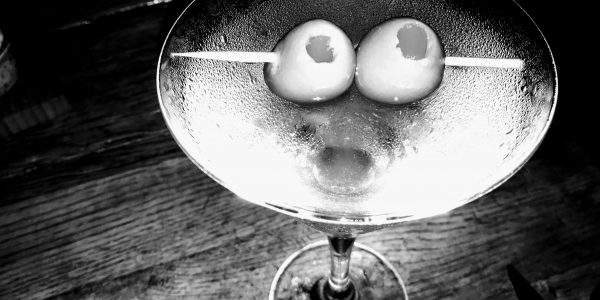
The classic martini glass is cone shaped. Suppose you have a generous bartender who fills your glass to the brim. You sip. Before you know it the martini is half way down the glass. How much drink is then left?

This is where you get to think like a mathematician. Although that is rarely so depressing as here.

The martini glass is a cone. To mathematicians the cone is a three-dimensional (although this can be generalised) body having a horizontal cross section that is the same shape at any position and where the size, say diameter, of that shape increases linearly with the height of the cross section. We think of the cone having circular cross sections. But that need not be the case. The Egyptian pyramids are also cones.

The bottom half, or any fraction, of the martini glass is therefore the same shape, technically “similar,” to the whole martini glass. This wouldn’t be true of, say, a champagne flute. The bottom of the flute is flattish, but higher up the sides are steep. The sides of the martini glass are always the same angle from bottom to the rim. And it doesn’t matter what that angle is, as long as it’s the same all the way up.

This means that the relationship between the volume of the liquid and its depth is very simple. You just take the fraction of the height of the level of the liquid to the depth of the original and then raise that to the power of three. Why three? Because we are working in three dimensions.

This means that if we are already (so soon?) half way down then the remaining volume is one eighth of what we started with.

You see why that is depressing. Most people when asked about this will say something like, oh there’s about one third left. But, no, it’s far worse than that.

I hope I haven’t spoiled your drink. Don’t be like me. As I see the level falling I am continually in advance thinking about how little is left. No wonder I have to order a second.

Oh, and avoid olives, they make the mathematics even more depressing, large olives, less alcohol.

A short poem to end.

“I like to have a martini

Two at the very most

After three I’m under the table

After four, I’m under my host.”

Dorothy Parker

There’s Nothing Better Than The Right Bad News!

There are many quotes by famous people about problems being opportunities.

The block of granite which was an obstacle in the pathway of the weak, became a stepping-stone in the pathway of the strong.” Thomas Carlyle.

Every problem is an opportunity in disguise.” John Adams.

Never let a good crisis go to waste.” Attributed to many.

All sensible and inspirational twists on setback.

We are going to apply a similar twist to rather gross facts. And in so doing highlight how mathematics can be used to frighten the unsuspecting.

Did you know that one in six mobile phones are contaminated with faecal matter? And cell phones carry ten times as many bacteria as toilet seats? Forty percent of office coffee mugs contain coliform bacteria, found in faeces. Forty percent! It gets worse. It is estimated that there is faecal matter on 72% of shopping carts. And shoes? Don’t go there.

Boy, how those numbers frighten us!

And those numbers also sell cleaning products. (Oh, sponges are about the most contaminated things there are.) And newspapers and magazines.

But we are looking at those numbers the wrong way. It’s the old problem/opportunity thing in disguise.

Have you used your cell phone today? Yes. Had a coffee in an office mug? Indeed. Worn shoes perhaps? Check. And are you currently ill? Me neither.

What’s the correct conclusion from the data then?

In the famous words of Corporal Jones, “Don’t panic!” As long as people’s health doesn’t get any worse then generally speaking the more germs there are the better. It simply mean that those germs aren’t as bad as their PR makes out.

Numbers Versus Symbols

Are you a numbers person or a symbols person?

Look, if you don’t know what I mean then it’s simple, you are a numbers person.

It’s a question I often ask of my audience. It helps me judge how best to explain some mathematical concept. Do I do it with 5s and 7s or with Xs and Ys? The hardest audience is one where’s there’s a 50-50 split between numbers and symbols people.

In my experience all audiences seem to be that 50-50 split. Hey ho.

What difference does this make? A lot.

A non-mathematical audience wants to see everything in terms of numbers. Ok, they might not remember what 7 time 8 is (who does?) but they’ll at least understand the concept. Seeing numerical examples is reassuring.

Numbers are great for illustrating how things work. Add, subtract, multiply, divide, raise to a power, etc., you can’t fool anyone with numbers. If it can be done with numbers then it must be easy.

But there’s a downside to using numbers. If I try to explain, I don’t know, double entry bookkeeping using numbers then how do I know whether the $19.99 that appears twice is the same $19.99 each time? You can’t see structure with just numbers. For that you need symbols.

If that $19.99 represents the same quantity then both times it would be an X. If they are different $19.99s, because one represents one sale and the other a different sale that just happens to have the same value, then one would be an X and the other a Y.

But that’s a rather trivial example. You can’t exactly do much in quantum physics if symbols make you uncomfortable.

Symbols are great for showing structure, abstraction is always necessary if you are to go beyond mere arithmetic. The problem with symbols is that some people are frightened by them. And if you and I are used to using different types of symbols it may take some time before we fully understand each other. One could even be accidentally or deliberately confusing, throw in a symbol without a proper explanation and before you know it everyone is lost.

This isn’t important just for me and my lectures, it also matters in the education of our children. There comes a point where if we want to educate a new generation of physicists, engineers, quants, and mathematicians generally, then we have to teach them to think in symbols. And in the abstract generally. Going too far down the mathematics-is-counting-apples route is counterproductive.

People can become terrified of the subject at an early age if taught badly, with the result that they are probably forever lost. How often at dinner parties have we mathematicians heard the ever-so-original response to what we do for a living “I was terrible at maths at school, me!”? Said almost boastfully. I read recently that the part of the brain that does maths is right next to the part that registers fear. I don’t know whether it’s true but it certainly makes sense.

I am forever hearing politicians wittering on about how maths education in schools needs to be made more fun, and more, what’s the word? Practical! Misguided fools! Not a single GCSE maths above grade D among them. The point of mathematics is that it is supposed to be abstract. If all your maths comes from counting apples then you are going to be stymied by the real thing. Mathematics is abstract, that is the beauty of it. And that’s what actually makes it fun. Teach mathematics properly, don’t terrify children by asking them how long it takes ten politicians to dig themselves into ten holes, explain to the young the beauty of the abstract.

“In mathematics you don’t understand things. You just get used to them.” John von Neumann

Now if only someone would explain double-entry bookkeeping to me using symbols.