The Wealth Manager

Following on from Credit Ratings, here’s a true story about how reassuring mathematical analysis can be. Until it turns out to be baloney. This story is also a warning about experts. Unfortunately, although there’s a lesson here we aren’t sure what it is. Sometimes you get screwed no matter how smart you are. Maybe that’s the lesson.

For Paul, 2007 had been a good year financially. His businesses, based around financial mathematics, publishing and training, were starting to take off. Being self employed his earnings were paid without any tax having been withheld. This meant he had to keep a regular check on how much he owed the UK’s Inland Revenue and, not wanting to end up behind bars like some tax-dodging TV evangelist, put it aside for later payment.

Paul is financially very conservative, he wanted to put this money somewhere incredibly safe, but he’s also a bit of a worrier. He knew that the complex financial instruments he worked with were poorly understood, and that their risk management was even worse. He knew that people in banks were confused about fundamental financial principles, and worse, that they didn’t know that they were confused. He knew that it’s important that the incentives of employees (the bankers) and the benefits of the owners and creditors (the man on the street) be lined up, and that in practice they rarely were. And long before it became fashionable he would tell anyone who would listen that the cleverest of the bankers didn’t know what they were doing.

Paul decided to speak to his Wealth Manager at his bank, B______s, to see if there was anywhere safe that he could leave it for a few months before paying the taxman. This was now the second half of 2008. The investment firm Bear Stearns had bitten the dust earlier in the year. So prudence had been the word of the days for several months now.

Paul mentioned these concerns to his Wealth Manager. And the Wealth Manager made some recommendations. One thing that Paul knew about was the Financial Services Compensation Scheme (FSCS), the UK’s version of the US’s Federal Deposit Insurance Corporation, which would at that time cover up to £50,000 in the event of a collapse. Well, the money that Paul owed Alistair Darling, the then Chancellor of the Exchequer, was quite a bit more than this. However, he also knew that there was a version of the financial guarantee that applied to insurance companies where the cover was 90% of any money lost, with no limit. Paul had done his research. So when the Wealth Manager mentioned that he had a couple of insurance-company products to offer, Paul naturally was keen.

There were two products on offer. They both had interest rates of about 4% annualized. One had a slightly higher return than the other. But the return wasn’t the point. The point of this exercise, remember, was to protect the money that he was holding onto on behalf of the Inland Revenue. The Wealth Manager gave the sales pitch for these two products. They seemed very simple, very “vanilla” in the financial jargon, basic short-term bonds. Credit ratings were mentioned and Paul does recall his sense that one of these investments was very, very, very safe, while the other was a mere very, very. The latter had the slightly higher rate of return. The greater the risk, the greater the expected return. That’s classics portfolio theory.

The conservative Paul opted for the lower return, thrice-very-safe investment. The government’s tax money, or at least 90% of it, was now secure.

This was a Thursday in September 2008.

That weekend brought the news of the collapse of Lehman Brothers and the near bankruptcy of AIG due to trading in complex credit derivatives, the very same instruments and models that Paul had said in 2006 “fill me with some nervousness and concern for the future of the global financial markets.”

Did we mention that it was an AIG insurance bond that Paul had bought?

Paul spoke to his Wealth Manager who reassured him that “there was nothing to worry about,” and that they “were speaking to AIG at the highest possible level.” This gave Paul a warm glow, he felt special. It was nice having a Wealth Manager. “Whatever happens to AIG, the money will be returned in 24 hours,” they said.

The next day the money had not reappeared, and B______s were now saying “48 hours” for the return. There was still nothing to worry about because insurance products come with a cooling-off period of 14 days.

Over the next few days the language of the Wealth Manager changed subtly, mention of cooling-off periods disappeared and timescales became more fluid. And suddenly there was talk of early-redemption penalties. This certainly didn’t fit in with the promise of a full refund in the first 14 days. Meanwhile AIG wasn’t getting any better.

Paul decided to take what little control he could, and started to make his own enquiries. He called AIG. To his surprise, considering their situation, the call was answered promptly, and he was put through to someone dealing with these bonds. Paul’s question was simple: “Was there or was there not a cooling-off period?” The AIG person did not know. She read out the bond’s particulars, the same paperwork that Paul had in front of him during the call. No mention was made in the paperwork of cooling-off periods or early redemption.

Paul called the Financial Services Authority, the then regulating body. He was going to ask about specifics of his bond and was expecting a response such as “Go to the FSA website, type in the company name, look for your bond in the dropdown menu, and the details will appear in a pop-up window.” It was the 21st century after all. Unfortunately the FSA’s representative said something somewhat different, in a very tired voice, something rather like “Do you know how many companies there are? Quite frankly, we don’t know who we regulate.” This was not looking promising.

Paul then went to the FSCS’s website. In the event of AIG collapsing they would be the ones to pick up the tab. Although they seemed very proud of their record in recompensing clients of failed institutions it was clear that they had never had to deal with anyone quite the size of AIG, a top-20 global company which sponsored Manchester United football team and, it seemed, much of the rest of the economy. (Forbes ranked them the 18th largest company in the world in 2008. “I bought one of your insurance bonds and all I got was this lousy Man United t-shirt.”) The case studies on the FSCS’s website were all firms that you’d never have heard of. Oh dear. It was now clear to Paul that he couldn’t depend on the insurance bond’s insurance.

Fortunately, this story has a reasonably happy ending – after a number of weeks nearly all the money was returned. Paul was in fact probably one of the more fortunate purchasers of this product. The BBC television journalist Jeremy Clarkson, who found himself in a similar situation (but with only the “very, very” safe AIG bond instead), said “I made strenuous efforts to get my money out of AIG as soon as the scale of its problems became apparent. But it wasn’t possible. Inwardly I was screaming. It’s my money. I gave it to you. You’ve squandered it on a Mexican’s house in San Diego and a stupid football team and that’s your problem. Not mine.” (Clarkson and Mexico have some history, but his observation had some truth to it, many mortgage brokers targeted specific racial groups for their sub-prime, teaser-rate, AIG-insured mortgages.)

But this was not a problem just for isolated investors. AIG was a major node in the financial system, and as its tangled web fell apart many companies, indeed entire countries, were severely affected by the ensuing economic mayhem. People lost their jobs, their homes, their life savings, even their lives (financial crises are strongly correlated with health crises and suicides).

Now, as tales from the credit crunch go this is not exactly movie material – it’s more the Big Short in reverse, not an attempt to make a killing from a crisis, but an attempt to save money to pay tax – but it does prove a point: We are only human, gullible, fallible, and despite our best efforts as prone as anyone to getting things wrong.

This brush with a failing, flailing insurance giant also taught Paul things he didn’t know, and reinforced a few that he did.

• Banks don’t know what they are talking about. They speak in jargon, much of which they don’t understand. But since there is no down side for them it doesn’t matter. To some extent you just have to hope for the best. Experts? Phooey!

• Regulators are clueless.

• Guarantees mean nothing. The FSCS paid out an average of £200million a year between 2001 and 2006. Between 2006 and 2011 that rose to an average of £5billion per annum, and they had to take out a loan from the Bank of England. But AIG was bailed out to the tune of $85billion. The numbers just don’t add up.

• Bailouts can be necessary, but only because some companies are so humungous in size. In some Darwinian sense entities should be allowed to collapse. But AIG was too big, its influence was everywhere. How many people had insurance through AIG? Just take car insurance, for example. How many cars would have been left uninsured, what repercussions would that have had? It’s impossible to tell.

• Being a mathematician doesn’t make you immune to the financial system’s occasional paroxysms – which is bad news because the system is effectively run by quants.

You could say that Paul should have been more careful. But that was precisely his goal. At some stage he had to take a chance on the advice he was given. And we know that that is risky. The alternative is to research and research and research, leaving no stone unturned … but the end result would be what? To not invest in anything? To not put your money in the bank even? Put it in government bonds? Invest it all in gold, or in property? Put it under the mattress? There’s no middle ground where absolute safety and trust overlap. But perhaps this new world in which there is no financial security – where a banknote, a cheque, a bond, a share certificate, can suddenly become irrelevant – is more natural. Perhaps the few decades in which banks were apparently safe was the anomaly, that a return to the precarious state that has been the norm throughout history, and still is in many countries, was inevitable.
Credit Ratings

Didn’t you feel proud when your teacher gave you an A+ at school? Or were you a C student, must try harder? Don’t tell us you were an F! My, you’ve done well…considering.

Just as teachers grade their students so there are businesses who grade investments. The three main credit rating agencies are Moody’s Investors Service, Standard & Poor’s and Fitch Ratings. Such agencies analyse the creditworthiness of companies, and their likelihood of going bust, as well as the risks in individual financial instruments. And they rate countries too.

Let’s take Moody’s for example. Their ratings start at the top, with the rating Aaa, “The highest quality and lowest credit risk” and “Best ability to repay short-term debt.” Below, and a smidgen riskier, comes Aa1, then Aa2, Aa3, followed by A1, A2 and A3. These are still supposedly low credit risk. We move even lower to the Bs with Baa1, Baa2, Baa3, then Ba1, and so on. All of these are higher risk with some “speculative elements.” By B1, B2 and B3 we are in high credit-risk territory. Finally come the Cs, the lowest of which is C itself “Rated as the lowest quality, usually in default and low likelihood of recovering principal or interest.”

Baa3 and above the instruments are supposedly “Investment grade.” Ba and below are non investment grade, also known as “junk.”

Good idea, no? And very helpful to investors. Knowing how professional bodies perceive risk in these companies and products can help investors make qualitative judgements about what to add to or subtract from their portfolios. But there’s more, there’s a quantitative angle to this as well. Let’s take as an example a bond rated Ba2. This bond has a price in the market. Suppose it yields 3% per annum. And suppose bank, i.e. risk-free, interest rates are 2%. Then (under lots of assumptions) these numbers can be interpreted as there being a 3-2=1% probability of the company defaulting on that bond in a year. (That’s 99% chance of getting one dollar and two cents back for your one-dollar investment, and 1% chance of nada.) Now we are in the realms of mathematics and can make quantitative judgements about whether Ba2 bonds are too risky, or which specific bonds to buy.

There are problems with this, or we wouldn’t be writing about this topic.

The first problem is the concept of quantifying probability of default. As a rule bankruptcy is a one-off event from which one doesn’t recover in the same form as before the bankruptcy. And as such a company only experiences this once. Therefore there’s not that much in the way of statistics for individual companies, only statistics about types of companies or companies with the same credit rating. There are parallels with health and death. Death is also a one-off event, at time of writing, and anyone who tells your life expectancy is basing that on tables of life expectancies of people with the same credit health rating as you, whether you smoke or not, take part in dangerous sports, etc. The mathematics of death and bankruptcy are very similar. More about life and death later.

But there’s a bigger problem. It concerns who pays for the credit rating. And it’s not who you’d expect. The credit rating on company XYZ is typically paid for by…company XYZ.

They need the rating to be taken as a serious investment, and they want it to be as high a rating as possible. The rating agency want their business and a happy customer. It doesn’t take a genius to figure out that their two interests are aligned. Had they been business partners then having perfectly aligned interests is exactly right. But here the rating agency is supposed to be acting as an unbiased middleman between the investor and the investment.

A third problem related to the above is that having competition among rating agencies might lead to companies choosing to work with those agencies that are the softest, who give the highest rating. None of this is helped by the lack of transparency about the rating process itself.

This is moral hazard.

Never mind all those problems. The main thing is that mathematics is involved. So it must be ok.

Numbers Versus Symbols

Are you a numbers person or a symbols person?

Look, if you don’t know what I mean then it’s simple, you are a numbers person.

It’s a question I often ask of my audience. It helps me judge how best to explain some mathematical concept. Do I do it with 5s and 7s or with Xs and Ys? The hardest audience is one where’s there’s a 50-50 split between numbers and symbols people.

In my experience all audiences seem to be that 50-50 split. Hey ho.

What difference does this make? A lot.

A non-mathematical audience wants to see everything in terms of numbers. Ok, they might not remember what 7 time 8 is (who does?) but they’ll at least understand the concept. Seeing numerical examples is reassuring.

Numbers are great for illustrating how things work. Add, subtract, multiply, divide, raise to a power, etc., you can’t fool anyone with numbers. If it can be done with numbers then it must be easy.

But there’s a downside to using numbers. If I try to explain, I don’t know, double entry bookkeeping using numbers then how do I know whether the $19.99 that appears twice is the same $19.99 each time? You can’t see structure with just numbers. For that you need symbols.

If that $19.99 represents the same quantity then both times it would be an X. If they are different $19.99s, because one represents one sale and the other a different sale that just happens to have the same value, then one would be an X and the other a Y.

But that’s a rather trivial example. You can’t exactly do much in quantum physics if symbols make you uncomfortable.

Symbols are great for showing structure, abstraction is always necessary if you are to go beyond mere arithmetic. The problem with symbols is that some people are frightened by them. And if you and I are used to using different types of symbols it may take some time before we fully understand each other. One could even be accidentally or deliberately confusing, throw in a symbol without a proper explanation and before you know it everyone is lost.

This isn’t important just for me and my lectures, it also matters in the education of our children. There comes a point where if we want to educate a new generation of physicists, engineers, quants, and mathematicians generally, then we have to teach them to think in symbols. And in the abstract generally. Going too far down the mathematics-is-counting-apples route is counterproductive.

People can become terrified of the subject at an early age if taught badly, with the result that they are probably forever lost. How often at dinner parties have we mathematicians heard the ever-so-original response to what we do for a living “I was terrible at maths at school, me!”? Said almost boastfully. I read recently that the part of the brain that does maths is right next to the part that registers fear. I don’t know whether it’s true but it certainly makes sense.

I am forever hearing politicians wittering on about how maths education in schools needs to be made more fun, and more, what’s the word? Practical! Misguided fools! Not a single GCSE maths above grade D among them. The point of mathematics is that it is supposed to be abstract. If all your maths comes from counting apples then you are going to be stymied by the real thing. Mathematics is abstract, that is the beauty of it. And that’s what actually makes it fun. Teach mathematics properly, don’t terrify children by asking them how long it takes ten politicians to dig themselves into ten holes, explain to the young the beauty of the abstract.

“In mathematics you don’t understand things. You just get used to them.” John von Neumann

Now if only someone would explain double-entry bookkeeping to me using symbols.

Experts? Phooey!

Experts, who needs ’em? Until recently we’d all have said everyone. But that pendulum has swung all the other way. Experts? They don’t know what they are talking about.

We understand this sentiment. We’ve criticized experts in finance and economics plenty enough. And rightly so. Those experts are to be blamed for their herd-like groupthink, that has so often turned out to be wrong.

And then there’s the media. In the race for newspaper sales they will one day tell us that research says red wine is bad for us. The next day it is good. And then bad again. End result is we don’t trust vinologists. Even though it’s the newspapers we shouldn’t trust.

But even the smartest of people can easily be fooled. And who better to do the fooling than a magician.

Between August 4th and 11th 1974 the Stanford Research Institute conducted experiments verify whether Uri Geller had “paranormal perception.”

The write up can be found in the CIA library here: https://www.cia.gov/library/readingroom/docs/CIA-RDP96-00791R000100480003-3.pdf Follow the link if you dare.

Part of the experiments involved an experimenter drawing a random image and Geller trying to reproduce it.

“In each of the eight days of this experimental period picture-drawing experiments were carried out. In each of these experiments Geller was separated from the target material either by an electronically isolated shielded room or by the isolation provided by having the targets drawn on the East coast. As a result of Geller’s success in this experimental period, we consider that he has demonstrated his paranormal perception ability in a convincing and unambiguous manner.”

Fooled them, Uri!

Hal Puthoff and Russell Targ who ran the experiments were already believers in the supernatural. And so possibly biased. They also didn’t do themselves any favours by allowing Geller access to an intercom during the experiment even though he was in the shielded room. Oh, and there was a hole in the wall between Geller and the experimenters. Even we can reproduce a random drawing if we can peak.

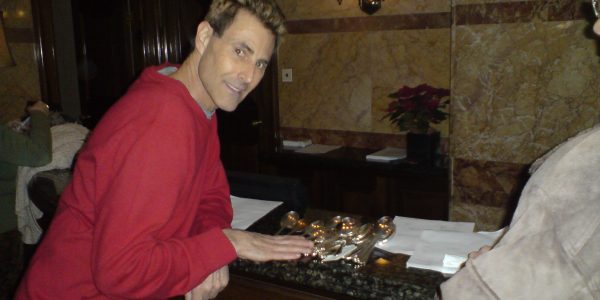
The image for this piece is a photograph taken by one of us at an auction at the Savoy, London. Uri Geller, who is the nicest man you could wish to meet, was there…bidding for spoons of course. We were lucky to witness one of his spoon-bending miracles from just a few feet away. He convinced us!

The Million Dollar Challenge is a prize offered by the foundation of the famous magician and debunker James Randi. It would be won by anyone “who can show, under proper observing conditions, evidence of any paranormal, supernatural, or occult power or event.” No one has ever won it.

Am I Being Random, Still?

What if we tossed a coin ten times and got

HHHHHHHHHH

and then we asked you to bet on the next toss?

Ten Hs in a row has a probability ½^10= 0.0009765625. Pretty unlikely. But any mathematician will tell you that this sequence, or a sequence of alternating H and T, or Hs and Ts representing the digits in the square root of two, or in pi, or any sequence whatsoever, are all equally likely (assuming an unbiased coin). Or rather, equally unlikely. But it’s hard to get one’s head around this fact. One can’t help feeling that if you were asked to bet after ten Hs then you should be suspicious.

Some people think that the Law of Averages applied here means that after so many Heads the next toss is more likely to be Tails to “balance things out.” This is called “The Gambler’s Fallacy.” The Law of Averages is a layman’s version of the more mathematical Law of Large Numbers. And is commonly misunderstood. In a nutshell, the Law of Large Numbers says that after a large number of trials, here tosses, the average should be close to the expected value, and get closer as the number of trials increases. If Heads counts as plus one and Tails as minus one then the expected value is zero for an unbiased coin. As the number of tosses increases so the average, the sum of the plus and minus ones divided by the number of tosses will converge to the expected value of zero. But this says absolutely nothing at all about the next toss, which will always be equally likely to be Head or Tail.

Casinos know all there is to be known about probability. And the Law of Large Numbers is tattooed on their black hearts in red ink. They know for example that each spin of the roulette wheel is independent of all previous spins. They know that ten Reds in a row at roulette is as likely to be followed by a Black as another Red. But they also know that many people don’t believe this simple fact of probability, and physics. They know about apophenia, that people see non-existent patterns, and that they play systems. And these are the people casinos adore, people who believe they can beat the casino and bet accordingly. That is why they will often encourage such people by presenting a list of recent numbers, printed out or on electronic signs near the wheel. Such data is also available online. A quick search will show you people discussing roulette patterns in all seriousness. Such people are the suckers that casinos rely on for business.

You can’t win at roulette.

Or can you? More anon.

In our ten-Heads-in-a-row example maybe the sequence is genuinely random, and it’s 50-50 what the next toss will be. Or maybe the coin is biased, or double headed. Or maybe you’re being lured into thinking it’s double headed and the next toss will be a Tail. On balance, this is a bet best avoided.

We’ve seen something not unlike this in the world of finance only a few years ago. The returns of Bernie Madoff’s fund. The S&P500 index goes up and down, then down and up, down down up up down, and so on, in what looks, and probably mostly is, a random fashion. (Even if the technical analysts think they can see patterns.) On the other hand Madoff’s returns go up, and up, and up, and… up,… in the hedge fund equivalent of a never-ending sequence of Heads. Too good to be true? Yes, and you’d be right to be suspicious.

Derren Brown gives the following wonderful performance. Picture this…

Derren stands on the stage with his goatee beard, suit from days of yore, and a microphone. He asks all members of the audience to stand and put a coin or other object into one of their hands. He says “Left” and everyone with the object in their right hand is asked to sit down. He repeats this several more times. Each time approximately half of the audience is asked to sit. He is down to three audience members still standing. Clearly these are all people with whom he has a “connection.” One of these he chooses and asks to join him on stage.

Derren asks her — in the youtube video of this the audience member is female — to put her hands behind her back and put a coin in one hand. She then holds her hands out in front. Derren has to say which hand the coin is in. His typical patter goes like “Last time you put the coin in your right hand so this time you think I’ll think you’ll put it in your left hand. But you know I’m thinking this so you’ll put it in your right again. But you know I know what you’re thinking so you’ll put it in your left. Forget that, actually your right hand is, you’ll notice, slightly lower than your left. And that’s because you are over compensating for the weight of the coin. Left!” And he’s right!

He does this many, many times in a row, each time correctly figuring out which hand the coin is in.

How does he do it?

Maybe it’s luck. Unlikely. One half to the power of… Or the audience member could have been a plant. Too easy, and also reputation harming. Maybe by pruning the audience he’s found someone who thinks like him. Maybe there’s some psychology going on. We’ve seen online discussions of all this. It’s all about Neuro Linguistic Programming was one suggestion. For example, looking up and to the left is, according to NLP, “Non-dominant hemisphere visualization i.e., remembered imagery.” So DB is looking at the person’s eyes for clues perhaps. Unfortunately NLP seems to have been largely discredited. Another suggestion was that some people were just easy to read. This was from the poker players, who told of easy-to-read poker “tells.”

Or maybe it’s a trick.

How it’s really done we won’t tell. Let’s just say it will set you back one of either a) many years of dedicated practice or b) a couple of hundred dollars. But the most important thing we gleaned from said discussion was how keen people were to believe in (pseudo) science rather than, ahem, perhaps trickery. Homeopathy, crystals, crop circles…just mention energy and vibrations and how some German scientist has proved everything while living on a diet of carrot juice and there’s a decent chunk of society that will believe you. Even smart people.

We tried to get DB to perform at one of our book launches. But DB’s fee of £30k for 40 minutes was, er, a bit steep for our publisher. And this was just as DB was becoming famous. Lord knows what he charges now.

Am I Being Random?

We’re going to be talking about patterns.

Look at the following three sequences of playing cards.

Sequence 1 Sequence 2 Sequence 3
7 ♣ J♠ 8♠
10♡ K♣ A♡
K♠ 5♣ A♢
3♢ 2♡ 7♡
6♣ 9♠ 3♣
9♡ A♠ 7♣
Q♠ 3♡ 9♣
2♢ 6♣ 2♡
5♣ 8♢ Q♠

What can you tell us about each of the three columns? Start with the one on the left.

A few seconds spent looking at the first column and you will notice a black-white-black-white pattern repeating. On closer inspection you might see Club-Heart-Spade-Diamond repeated. Finally, if you are really paying attention, you’d see that the numbers increase by three each time: 7 to 10 to 13 (King) to 3 to 6 to 9 etc. We have here a simple pattern, and it gives us a stacked deck.

Stacked decks are very useful to the magician in many circumstances. For example, suppose you are asked to pick a card and the magician peaks at the one next to it then he immediately knows which is yours. Or if you take one out and put it back elsewhere he will know which is the one out of sequence, and that’s the one you picked. Those are two easy, beginner, tricks. More sophisticated effects use the fact that the magician knows the position of each card in the deck.  

The particular stack in the first column goes by the name “Si Stebbins,” the stage name of William Coffrin. Although there is a pretty clear pattern here — the suit order is easily remembered by the mnemonic CHaSeD — believe us when we say that with suitable distractions the layperson is unlikely to spot this when the magician briefly waves the deck in front of them. But sometimes the magician needs a stack that can stand up to closer scrutiny…

The second column is also part of a stacked deck, this time the Aronson stack, invented by magician, mentalist and lawyer, Simon Aronson. The stack is designed to look random but also once you’ve memorized this stack there are many tricks that work simply because of the clever order of the cards.

The third column is genuinely random, in the sense that we shuffled a deck and wrote down the first nine cards.

Being able to see patterns is important.

However humans also tend to see patterns even when there’s no pattern to be seen. The tendency to see patterns in random data is known as apophenia. We see shapes of animals in clouds. Or images of Jesus in a slice of toast. In finance the technical analysts promote the idea of trendlines and patterns in stock-market graphs, even though the proper statistics tell us that such lines and patterns have no predictive power. In extreme cases apophenia can be an indicator of delusional thinking or schizophrenia.

The magician knows about apophenia and so his goal with a stacked deck is to have it look random to the casual observer (or even to someone who “burns” the cards, i.e. stares intently at them). But there’s a big difference between being random and looking random, given the human urge to see patterns.

Let’s move on from cards to coins, and look at another sequence. Toss a coin many times, write down “H” when it lands Heads up, and “T” if Tails up. Here’s an example:

HTTTTHTTTTHHTHHH…

That’s a nice random sequence, no?

No! One H, four Ts, one H, four Ts, two Hs, one T, three Hs,… = 1.414213… The first digits in the square root of two.

How about this one:

THTTTTTTH…

You must be onto us by now. That’s a lot of Ts in a row, must be the part of some pattern. No! We generated that in Excel using one of its random number generators and it was literally the first sequence we did. We see patterns when there aren’t any and miss patterns when there are.

Exercise: Try writing down a sequence of Hs and Ts and try to make it look random. You’ll probably be reluctant to put down six Hs or Ts in a row. It just wouldn’t look sufficiently random.

Dumbing Down

In the once great Britain politicians are now pretty dumb.

Royal Statistical Society did a survey of UK Members of Parliament, asking them if a coin is tossed twice what is the probability of getting two heads.

You know the answer I am sure. It is 25%. The probability of the first head is 0.5, the probability of the second is 0.5. The tosses are independent so multiply. Simple.

But MPs are not as smart as you. Only 40% of MPs got the answer right. But if you break that down by party, 53% of Conservative MPs got the right answer. But only 23% of Labour. Some MPs said the answer was one in three. They probably thought that a head then a tail was the same as a tail then a head.

But then I don’t think anyone since Lenin has thought Marxists are smart. And no one thought Lenin was smart, but they didn’t dare tell anyone.

The assumption of independence is crucial. A large numbers of the MPs gave the answer 50%. That would be correct if the second toss was guaranteed to be the same as the first. That would be perfect correlation.

The paediatrician Sir Roy Meadow was often called upon as an expert witness for the prosecution in trials of parents accused of child murder.

In the sad case of Sally Clark who lost two babies, at 8 weeks and 11 weeks, Professor Meadow said the chance of the deaths being due to cot death or Sudden Infant Death Syndrome was 73 million to one. Sally Clark was found guilty of murder.

Meadow seems to have come to his conclusion by squaring the one-in-8,543 chance of a child in a middle-class family falling victim to a cot death that he had read in an article. That probability for a single incidence of cot death is incorrect. But then assuming independence and squaring is irresponsible. There could well be environmental or genetic factors which make the probability of two such deaths far more likely.

The President of the Royal Statistical Society published an open letter outlining the professor’s errors (there were more than just the assumption of independence). Sally Clark’s conviction was overturned.

This was not the only case that Roy Meadow had been involved in. Many were similarly reopened. Eventually Professor Sir Roy Meadow was banned from expert witness work.

Fooling Churchill

The magician Paul Curry created the following trick known as either “Out of This World” or “The Trick that Fooled Churchill” since it was supposedly performed for him during the war.

The Effect

The Magician holds a pack of cards and deals out one red and one black card face up side by side. These are the ‘header cards.’ He hands the deck to the Subject and asks him to deal the cards one at a time face down and try to intuit which cards are red and which black and put them face down under the corresponding face up header card. Half way through the deck the Magician takes back the cards, puts down two new header cards and asks the Subject to continue. The reason for this interruption might be something about eliminating left/right bias. When the Subject has finished the Magician picks up the groups of cards, turns them over and reveals that the Subject has somehow got every single card right!

This can be passed off as a pure magic trick or as a demonstration of Extra Sensory Perception, ESP.

The Method

The deck is set up initially so that all reds are in the top half and all blacks at the bottom. As the Subject randomly puts down the first half of the deck into two columns the Magician has to keep count so that he knows when the red cards end and the black begin. Leaving one red card for a new header, the Magician puts down a face up red, and a face up black card. (Obviously this should be done with some fiddling through the cards so that it looks like the Magician doesn’t himself know which are red and which black.) The Subject then continues with the division of the face down cards into the two piles. Now it’s just a matter of the Magician picking up the cards in a way that distracts the Subject from the fact that the he is swapping piles over.

It is possible for the Subject to place the cards as if they are all red or all black. This would clearly mess up the Effect and so requires some handling by the Magician. The Magician can also intervene a few times, as a gag, to say “Just a second, I think that one is wrong. Do you mind if I move it to the other column? But I think generally you’re doing great!”

Penney’s Game

Here is a trick you can do with pennies. It is called Penney’s game. It is named after Walter Penney. Or was he named after the game? No one knows.

You choose a sequence of heads and tails, three in total. Say HHH. I then choose another sequence, say THH. We now toss a coin over and over, noting the order of heads and tails. If your sequence occurs first then you win, if mine then I win.

Now surely is obvious that both players have an equal probability of winning? Simply because heads and tails are equally likely, as are all the combinations of the three in the sequence. But this not obvious to the mathematician. And here the mathematician is right.

(If you thought equally likely then I’ve got a bridge to sell you.)

Mathematicians never take anything for granted. Even the most obvious idea must be rigorously proved before the mathematician can get any sleep. Here’s something that surely is obvious, but turns out not to be. And it makes a great trick to play in a bar. Yes, another one. Some people say I spend too much time in bars. I say, “Your round.”

With the two sequences chosen here, the first player has HHH and the second THH, the second player has a seven in eight chance of winning. Now how can that be?

We can see this easily with the above choices for the two players. If ever a T is tossed then the first player cannot possibly win:

XXXXXTHH

has to come before

XXXXXTHHH.

Therefore the only way the first player can win is if the first three tosses are all heads, which has a small one in eight chance. The same principle applies to other combinations, albeit not so trivial to demonstrate. In this table we see how the second player should choose his sequence to maximize his probability of winning:

1st player’s choice 2nd player’s choice Odds in favour of 2nd player
HHH THH 7 to 1
HHT THH 3 to 1
HTH HHT 2 to 1
HTT HHT 2 to 1
THH TTH 2 to 1
THT TTH 2 to 1
TTH HTT 3 to 1
TTT HTT 7 to 1

If you want to play this in a bar then the way to remember the optimum is take the first player’s second choice, swap it (from H to T or vice versa) then add on his first two choices.

One In 52 Continued

Before we explain the significance of this question you’ll need some background. I am giving one of my training courses to a group of investment bankers, hedge fund managers, risk managers, regulators, anyone with an interest in the mathematical side of finance. The audience will be mostly those with an economics or finance degree, some scientists, with the occasional lawyer. I know this sort of audience well. I know that they’ll have a pretty decent grasp of some narrow areas of mathematics and statistics, but they’ll probably wildly overestimate their abilities. And despite their six-figure salaries they won’t know when and where to apply what mathematics they do know. With this trick I’m hoping to hammer home asap that there’s more to the application of mathematics than what you find in the text books. And I’m warming my audience up. Lectures with audience interaction are more memorable than those without. And those with the invisible deck of cards are even better.

I started this segment of my course by asking the audience to imagine that they are at a magic show. I then ask someone to name their favourite card. Then by getting them to say how many cards there are in a normal deck I make the final question look like it is about probability theory, “What is the probability that…?” And people working in finance, like this audience, use probability theory and assumptions about the stock market’s random behavior as their very bread and butter. One of the most famous, non-technical, books on the mathematics of the stock market by Burton Malkiel is even called “A Random Walk Down Wall Street.”

But it’s too easy to fall back on mathematics if that’s your field of expertise. And sometimes that mathematics might not only be irrelevant, but also dangerous.

As we’ll see, context is all when it comes to mathematics, and magic.

We’d like you, fragrant reader, to take part in my exercise. Imagine you are in the audience, imagining you are at a magic show. What do you think is the probability that the card that I have chosen is the Ace of Spades? (Yes, yes, we know I didn’t really do the trick, I pretended to do the trick. So I could just as easily pretend to cheat. But we want you to imagine you are in the audience of a real magic show, and the real magician has a real deck of cards. One day I will learn how to do this trick properly myself.)

The question to you is what is the probability that the card taken from the deck is the Ace of Spades?

Think about this question while we talk a bit about risk management. Feel free to interrupt as soon as you have an answer. Oh, you already have an answer? What is that you said, one in 52? On the grounds that there are 52 cards in an ordinary pack. It certainly is one answer. But aren’t you missing something, possibly crucial, in the question? Ponder a bit more. Clue: Context.

One aspect of risk management is that of “scenario analysis.” Risk managers in banks have to consider possible future scenarios and the effects they will have on their bank’s portfolio. They like to assign probabilities to each event and then estimate the distribution of future profit and loss. Of course, this is only as useful as the number of scenarios you can think of. And you need to know those probabilities.

You have another answer already? You’d forgotten that it was a magician pulling out the card. Well, yes, we can see that might make a difference. So your answer is now that it will be almost 100% that the card will be the Ace of Spades, a magician is hardly going to get this trick wrong. That’s quite a different answer from the one in 52. Are you right? Well, think just a while longer.

Sometimes the impact of a scenario is quite easy to estimate. For example, if interest rates rise by 1% then the bank’s portfolio might fall in value by so many hundreds of millions. But estimating the probability of that interest rate rise in the first case might be quite tricky. And more complex scenarios might not even be considered. What about the effects of combining rising interest rates, rising mortgage defaults and falling house prices in America? That’s less a matter of probabilities than, with hindsight, an inevitability. And by assuming that the laws of probability trump causality leads to overconfidence that all is well with the world.

Most mathematically inclined finance people when asked the magician question, usually give the one in 52 answer – because they ignore the context, it’s a magic show. It often requires quite an awful lot of major hinting before the “quants,” the banks’ tame mathematicians, even begin to think beyond pure probability, and bring in context. Rather frighteningly, some people trained in the higher mathematics of risk management still don’t see the second answer, the 100%, even after being told. It’s as if the context is irrelevant. Or they willfully ignore the context to keep it to a nice simple question in probability theory. Heaven forbid that they should consider messy reality.

I have asked this question at many risk-management events, so I have some idea of the statistics of the answers versus the make-up of the audience. I once asked the question at an actuarial conference. Out of the audience of one hundred there were two who absolutely and categorically refused to entertain the idea of anything other than the grade-school one-in-52 answer. No amount of discussion of context and the reality of magic shows persuaded them to even entertain the possibility of another answer. One member of that audience shouted out “Those two work for a regulator!” I thought this was a joke. But it wasn’t. Seriously, the only members of the audience stuck on the mathematics, unable to see the context, were the only two from a financial regulator. Surely regulators more than anyone must consider reality rather than theory? Apparently not. These two regulators were asked to justify their answers. Their explanation involving concepts from higher probabilistic mathematics was met with hoots of amusement from the rest of the audience.

Actually there is no single, correct answer. This is really an exercise in creative thinking – and non-mathematicians are usually better at spotting this. And creative thinking is something that risk managers and regulators need to get good at. (And less of the creative accounting.)

For example, one possible answer to our card-trick question is zero. There is no chance that the card is the Ace of Spades. I usually reveal that the card I pulled from the deck is… “The Three of Clubs! D’oh!” Has the trick gone wrong?

This trick is too simple for any professional magician. Maybe the trick is a small part of a larger effect, getting this part “wrong” is designed to make a later feat more impressive … the Ace of Spades is later found inside someone’s pocket. Or, our favorite, tattooed on the magician’s arm. Very, very rarely does anyone ever think of these possibilities. (And if you did, then you should be in the Magic Circle.)

The answer one in 52 is almost the answer least likely to be correct. Magicians rarely rely on probability.

Risk management requires an open mind – but a traditional education in finance often works to close it.

So, what was your final answer?

Did you say one in 52, and stick with that answer? You are going to be one tough critic then.

Did you say one in 52 and then change your mind? Good, we can work with you.

Did you say 100%? Excellent.

Did you say zero? We don’t believe you! (You’re not David Blaine are you? We know he’s a fan but…)

Did you say 37.26%? Interesting.

Running with the idea that the magician deliberately gets the card wrong in an end-of-second-act cliffhanger there is the tiniest of probabilities that he fails…i.e. he unintentionally picks out the Ace of Spades. The correct card. And what’s the probability of that? One in 52! We’re back where we started. Does your brain hurt yet? I have never known anyone to take the analysis and the context as far as this. If you did then we definitely want to hear from you.