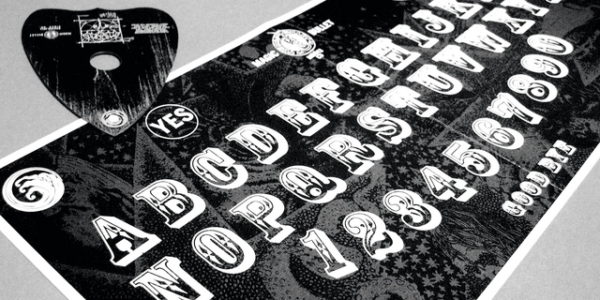
Automatic Writing

On the topic of gullibility, here is a story that we like to share with our banker friends during our “seminars” on magical thinking (much better paid than real magic shows and the audience is less demanding).

In the summer of 1922, Sir Arthur Conan Doyle invited his friend, the magician Harry Houdini, and his wife Bess to join them for a week at Atlantic City. The vacation was going well, and everyone was having a good time, until Sir Arthur suggested that his wife Jean could put Houdini in touch with Houdini’s beloved mother Cecelia, who had died almost a decade earlier.

Sir Arthur was of course famous for being the creator of the ultimate scientific rationalist Sherlock Holmes, however he had also been converted to spiritualism after losing his son and brother during World War I. When he saw Houdini perform his act during a tour through England, he became convinced that Houdini had genuine supernatural powers. And he had great faith in his wife’s talent as a medium.

For Houdini, the situation was complicated. For one thing, he knew that his illusions were the product of stagecraft, not magic, and that Sir Arthur was overly gullible. He had also authored a book in which he revealed the tricks of a number of magicians and mediums. It was inspired in part by earlier, unsuccessful attempts to contact his mother, who he had seen as “the guiding beacon of my life.” But at the same time, he liked Doyle – and he really missed his mother. So he agreed to give it a go.

The séance was held at the Doyles’ hotel room. After turning down the lights, Lady Jean went into what appeared to be a deep trance. Then she grabbed a pen and started scribbling manicly on sheets of paper – what spiritualists called automatic writing – as if she were channeling the spirit of Houdini’s mother. Houdini read the sheets as she finished them, fifteen in all before she wound herself down. But his awkward feelings were not relieved.

The letter said all the usual things that one might expect from a long-dead mother (love you, missing you, the Doyles are great, etc.) but it was written in perfect English (his mother was Hungarian and spoke little English), the first sheet was decorated with a cross (she was a Jew), she didn’t mention that it was her birthday that day, and so on. He didn’t need to be Sherlock Holmes to realise he was being conned.

Not wanting to spoil the evening, or their relationship, he didn’t say anything at the time; but matters came to a head later that year when he wrote an article saying that no medium had ever been proven to be able to contact the dead. Evidence-based, they were not. Doyle took it personally, and the friendship was effectively over.

Doyle continued to write books and give lectures promoting spiritualism. Houdini remained a skeptic, but still held out some hope that it might be possible to communicate with the departed – being a magician didn’t make him completely immune to magical thinking. He arranged a code with his wife, so that if she tried to contact him after his death through a medium she would know whether it was genuine. After he died in 1926, of a ruptured appendix on Halloween, Bess kept trying, but to no avail. She finally stopped the séances in 1936, famously announcing that “ten years is long enough to wait for any man.”

By that time, the craze for spiritualism was already losing some of its energy. And today, of course, most people see séances as something from an earlier, less scientific age. We know that for many people the desire to communicate with lost relatives is so great that they are willing to suspend disbelief; and that doing so makes them susceptible to the con-artists and fraudsters who Houdini had worked to debunk. But that doesn’t mean that we are immune to the power of magic – even when we are trying to be rational.

Bankers (and others) beware.

Throat Reading

Magic brings out the gullibility in people. This is good and is bad. It is good for magicians. But it is bad if powerful people are dumb. We can therefore use magic to figure out, to some extent, who are gullible.

Nobody is more powerful these days than bankers. So in some lectures I use tricks to their highlight gullibility.

My favourite is the following. (I write this like a screenplay, maybe a big a producer reads this blog.)

INT. LECTURE ROOM – DAY

PAUL walks among tables set out in CABARET STYLE. The seated audience members’ eyes follow him. PAUL is carrying a DECK OF CARDS? PAUL stops in front of one person and holds out the fanned deck face down.

PAUL

Pick a card, as they say, any card.

The audience member picks a card, and makes eye contact with PAUL.

PAUL (CONT’D)

Look at the card. Are you happy with your choice? Now please stand. And don’t let anyone see the card.

PAUL walks back to his desk at the front of the room and puts down the deck. He turns to face the audience.

PAUL [ADDRESSING THE AUDIENCE]

I want you all to help me. I’m no magician, I have no clue what card our friend is holding. But I think we can use science to figure it out.

PAUL turns to the subject holding the card.

PAUL (CONT’D)

When I tell you I want you to shout out the name of the card as loudly as possible but only in your head. Got that? Only in your head. Please don’t say anything out loud. Just scream it inside your head. You look like the sort of person who screams internally a lot. That’s why I chose you.

After a short pause PAUL grins. The subject smiles weakly back.

PAUL (CONT’D)

Ok. Scream!

Nothing happens. But PAUL turns excitedly to look at the audience.

PAUL (CONT’D)

Did you see that? Yes? No? It’s difficult until you’ve had practice. Just look at his throat. Let’s try that again. This time please only shout the suit of the card. And everyone focus on his throat. Go!

PAUL is clearly excited.

PAUL [ADDRESSING THE AUDIENCE]

You saw it that time, no? Did you see his throat move, ever so slightly but just enough. What do you think? Spades, hearts, clubs, diamonds? What did you see as his throat moved?

No one says anything.

PAUL [POINTING AT ONE AUDIENCE MEMBER]

What do you think? Spades?

There is no reaction from the audience member.

PAUL (CONT’D)

I don’t think that’s it. Who thought Hearts?

Still no audience reaction. But PAUL nods at a few people. Clearly this crowd is a bit shy. Sometimes you have to pretend to get responses from the audience just to get the party going.

PAUL (CONT’D)

You did? Yes. And you? So maybe half of you thought he shouted Hearts. [NOW ADDRESSING THE SUBJECT] Are they right? Was it Hearts?

SUBJECT

Yes.

I continue in this vein, moving on to the number of the card, and the audience seems to agree that the card is the Five of Hearts. Amazingly this turns out to be correct. This “Throat Reading” is very powerful.

If you google “throat reading” you’ll find lots of comparisons with Neuro Linguistic programming (NLP), how it’s important to work with the right subject, how it works best if the subject is slightly tense (so it’s particularly good in the above setting), how the first language of the speaker makes a big difference (Dutch speakers are apparently the easiest to read), and so on. Research goes back to the 1950s, and there’s even some association with the MKUltra project. Apparently one could extract information from individuals under the influence of certain drugs, mescaline for example, even if they didn’t actually speak! Subjects can maintain control of their breathing but the drugs weaken their control of the larynx. And so you can observe movement, and with skill interpret what they aren’t saying out loud.

How gullible can you be?

Oh, come on! You didn’t fall for all that science nonsense did you? You’re a sucker for a bit of scientific mumbo jumbo then? No, surely you, dear reader, know that it’s all total baloney? If you do google “throat reading” all you’ll see are links to the British mentalist Derren Brown (there’s a YouTube video). No, this is a card trick, goddamit! And pretty elementary, like all of my tricks. (DB and I created this presentation independently, FYI.)

I know from doing this simple trick at my lectures that a decent portion of my audience will fall, hook, line and sinker, for the scientific explanation. Many will be unsure. (Most will be thinking when is the next tea break.)

Mathemagical Thinking Lesson

Ok, so no mathematics here, just pseudoscience. I use this trick to show people just how easy it is to be gullible. I hope it gets my audience into the right state of mind to start to question standard practices and received wisdom.

People like the idea of “tells,” body language. What were Harry and Meghan thinking during their Oprah interview? If anything. This trick taps into that. And notice how I threw in a bit of conspiracy stuff, MKUltra. That also appeals to a certain, frighteningly large, audience.