Numbers Versus Symbols

Are you a numbers person or a symbols person?

Look, if you don’t know what I mean then it’s simple, you are a numbers person.

It’s a question I often ask of my audience. It helps me judge how best to explain some mathematical concept. Do I do it with 5s and 7s or with Xs and Ys? The hardest audience is one where’s there’s a 50-50 split between numbers and symbols people.

In my experience all audiences seem to be that 50-50 split. Hey ho.

What difference does this make? A lot.

A non-mathematical audience wants to see everything in terms of numbers. Ok, they might not remember what 7 time 8 is (who does?) but they’ll at least understand the concept. Seeing numerical examples is reassuring.

Numbers are great for illustrating how things work. Add, subtract, multiply, divide, raise to a power, etc., you can’t fool anyone with numbers. If it can be done with numbers then it must be easy.

But there’s a downside to using numbers. If I try to explain, I don’t know, double entry bookkeeping using numbers then how do I know whether the $19.99 that appears twice is the same $19.99 each time? You can’t see structure with just numbers. For that you need symbols.

If that $19.99 represents the same quantity then both times it would be an X. If they are different $19.99s, because one represents one sale and the other a different sale that just happens to have the same value, then one would be an X and the other a Y.

But that’s a rather trivial example. You can’t exactly do much in quantum physics if symbols make you uncomfortable.

Symbols are great for showing structure, abstraction is always necessary if you are to go beyond mere arithmetic. The problem with symbols is that some people are frightened by them. And if you and I are used to using different types of symbols it may take some time before we fully understand each other. One could even be accidentally or deliberately confusing, throw in a symbol without a proper explanation and before you know it everyone is lost.

This isn’t important just for me and my lectures, it also matters in the education of our children. There comes a point where if we want to educate a new generation of physicists, engineers, quants, and mathematicians generally, then we have to teach them to think in symbols. And in the abstract generally. Going too far down the mathematics-is-counting-apples route is counterproductive.

People can become terrified of the subject at an early age if taught badly, with the result that they are probably forever lost. How often at dinner parties have we mathematicians heard the ever-so-original response to what we do for a living “I was terrible at maths at school, me!”? Said almost boastfully. I read recently that the part of the brain that does maths is right next to the part that registers fear. I don’t know whether it’s true but it certainly makes sense.

I am forever hearing politicians wittering on about how maths education in schools needs to be made more fun, and more, what’s the word? Practical! Misguided fools! Not a single GCSE maths above grade D among them. The point of mathematics is that it is supposed to be abstract. If all your maths comes from counting apples then you are going to be stymied by the real thing. Mathematics is abstract, that is the beauty of it. And that’s what actually makes it fun. Teach mathematics properly, don’t terrify children by asking them how long it takes ten politicians to dig themselves into ten holes, explain to the young the beauty of the abstract.

“In mathematics you don’t understand things. You just get used to them.” John von Neumann

Now if only someone would explain double-entry bookkeeping to me using symbols.

Experts? Phooey!

Experts, who needs ’em? Until recently we’d all have said everyone. But that pendulum has swung all the other way. Experts? They don’t know what they are talking about.

We understand this sentiment. We’ve criticized experts in finance and economics plenty enough. And rightly so. Those experts are to be blamed for their herd-like groupthink, that has so often turned out to be wrong.

And then there’s the media. In the race for newspaper sales they will one day tell us that research says red wine is bad for us. The next day it is good. And then bad again. End result is we don’t trust vinologists. Even though it’s the newspapers we shouldn’t trust.

But even the smartest of people can easily be fooled. And who better to do the fooling than a magician.

Between August 4th and 11th 1974 the Stanford Research Institute conducted experiments verify whether Uri Geller had “paranormal perception.”

The write up can be found in the CIA library here: https://www.cia.gov/library/readingroom/docs/CIA-RDP96-00791R000100480003-3.pdf Follow the link if you dare.

Part of the experiments involved an experimenter drawing a random image and Geller trying to reproduce it.

“In each of the eight days of this experimental period picture-drawing experiments were carried out. In each of these experiments Geller was separated from the target material either by an electronically isolated shielded room or by the isolation provided by having the targets drawn on the East coast. As a result of Geller’s success in this experimental period, we consider that he has demonstrated his paranormal perception ability in a convincing and unambiguous manner.”

Fooled them, Uri!

Hal Puthoff and Russell Targ who ran the experiments were already believers in the supernatural. And so possibly biased. They also didn’t do themselves any favours by allowing Geller access to an intercom during the experiment even though he was in the shielded room. Oh, and there was a hole in the wall between Geller and the experimenters. Even we can reproduce a random drawing if we can peak.

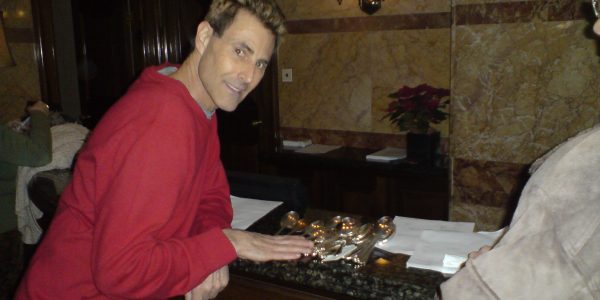
The image for this piece is a photograph taken by one of us at an auction at the Savoy, London. Uri Geller, who is the nicest man you could wish to meet, was there…bidding for spoons of course. We were lucky to witness one of his spoon-bending miracles from just a few feet away. He convinced us!

The Million Dollar Challenge is a prize offered by the foundation of the famous magician and debunker James Randi. It would be won by anyone “who can show, under proper observing conditions, evidence of any paranormal, supernatural, or occult power or event.” No one has ever won it.

Am I Being Random, Still?

What if we tossed a coin ten times and got

HHHHHHHHHH

and then we asked you to bet on the next toss?

Ten Hs in a row has a probability ½^10= 0.0009765625. Pretty unlikely. But any mathematician will tell you that this sequence, or a sequence of alternating H and T, or Hs and Ts representing the digits in the square root of two, or in pi, or any sequence whatsoever, are all equally likely (assuming an unbiased coin). Or rather, equally unlikely. But it’s hard to get one’s head around this fact. One can’t help feeling that if you were asked to bet after ten Hs then you should be suspicious.

Some people think that the Law of Averages applied here means that after so many Heads the next toss is more likely to be Tails to “balance things out.” This is called “The Gambler’s Fallacy.” The Law of Averages is a layman’s version of the more mathematical Law of Large Numbers. And is commonly misunderstood. In a nutshell, the Law of Large Numbers says that after a large number of trials, here tosses, the average should be close to the expected value, and get closer as the number of trials increases. If Heads counts as plus one and Tails as minus one then the expected value is zero for an unbiased coin. As the number of tosses increases so the average, the sum of the plus and minus ones divided by the number of tosses will converge to the expected value of zero. But this says absolutely nothing at all about the next toss, which will always be equally likely to be Head or Tail.

Casinos know all there is to be known about probability. And the Law of Large Numbers is tattooed on their black hearts in red ink. They know for example that each spin of the roulette wheel is independent of all previous spins. They know that ten Reds in a row at roulette is as likely to be followed by a Black as another Red. But they also know that many people don’t believe this simple fact of probability, and physics. They know about apophenia, that people see non-existent patterns, and that they play systems. And these are the people casinos adore, people who believe they can beat the casino and bet accordingly. That is why they will often encourage such people by presenting a list of recent numbers, printed out or on electronic signs near the wheel. Such data is also available online. A quick search will show you people discussing roulette patterns in all seriousness. Such people are the suckers that casinos rely on for business.

You can’t win at roulette.

Or can you? More anon.

In our ten-Heads-in-a-row example maybe the sequence is genuinely random, and it’s 50-50 what the next toss will be. Or maybe the coin is biased, or double headed. Or maybe you’re being lured into thinking it’s double headed and the next toss will be a Tail. On balance, this is a bet best avoided.

We’ve seen something not unlike this in the world of finance only a few years ago. The returns of Bernie Madoff’s fund. The S&P500 index goes up and down, then down and up, down down up up down, and so on, in what looks, and probably mostly is, a random fashion. (Even if the technical analysts think they can see patterns.) On the other hand Madoff’s returns go up, and up, and up, and… up,… in the hedge fund equivalent of a never-ending sequence of Heads. Too good to be true? Yes, and you’d be right to be suspicious.

Derren Brown gives the following wonderful performance. Picture this…

Derren stands on the stage with his goatee beard, suit from days of yore, and a microphone. He asks all members of the audience to stand and put a coin or other object into one of their hands. He says “Left” and everyone with the object in their right hand is asked to sit down. He repeats this several more times. Each time approximately half of the audience is asked to sit. He is down to three audience members still standing. Clearly these are all people with whom he has a “connection.” One of these he chooses and asks to join him on stage.

Derren asks her — in the youtube video of this the audience member is female — to put her hands behind her back and put a coin in one hand. She then holds her hands out in front. Derren has to say which hand the coin is in. His typical patter goes like “Last time you put the coin in your right hand so this time you think I’ll think you’ll put it in your left hand. But you know I’m thinking this so you’ll put it in your right again. But you know I know what you’re thinking so you’ll put it in your left. Forget that, actually your right hand is, you’ll notice, slightly lower than your left. And that’s because you are over compensating for the weight of the coin. Left!” And he’s right!

He does this many, many times in a row, each time correctly figuring out which hand the coin is in.

How does he do it?

Maybe it’s luck. Unlikely. One half to the power of… Or the audience member could have been a plant. Too easy, and also reputation harming. Maybe by pruning the audience he’s found someone who thinks like him. Maybe there’s some psychology going on. We’ve seen online discussions of all this. It’s all about Neuro Linguistic Programming was one suggestion. For example, looking up and to the left is, according to NLP, “Non-dominant hemisphere visualization i.e., remembered imagery.” So DB is looking at the person’s eyes for clues perhaps. Unfortunately NLP seems to have been largely discredited. Another suggestion was that some people were just easy to read. This was from the poker players, who told of easy-to-read poker “tells.”

Or maybe it’s a trick.

How it’s really done we won’t tell. Let’s just say it will set you back one of either a) many years of dedicated practice or b) a couple of hundred dollars. But the most important thing we gleaned from said discussion was how keen people were to believe in (pseudo) science rather than, ahem, perhaps trickery. Homeopathy, crystals, crop circles…just mention energy and vibrations and how some German scientist has proved everything while living on a diet of carrot juice and there’s a decent chunk of society that will believe you. Even smart people.

We tried to get DB to perform at one of our book launches. But DB’s fee of £30k for 40 minutes was, er, a bit steep for our publisher. And this was just as DB was becoming famous. Lord knows what he charges now.

Am I Being Random?

We’re going to be talking about patterns.

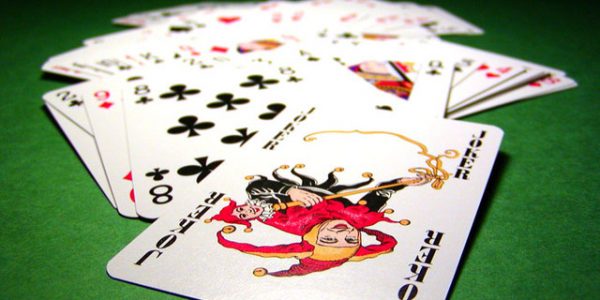
Look at the following three sequences of playing cards.

Sequence 1 Sequence 2 Sequence 3
7 ♣ J♠ 8♠
10♡ K♣ A♡
K♠ 5♣ A♢
3♢ 2♡ 7♡
6♣ 9♠ 3♣
9♡ A♠ 7♣
Q♠ 3♡ 9♣
2♢ 6♣ 2♡
5♣ 8♢ Q♠

What can you tell us about each of the three columns? Start with the one on the left.

A few seconds spent looking at the first column and you will notice a black-white-black-white pattern repeating. On closer inspection you might see Club-Heart-Spade-Diamond repeated. Finally, if you are really paying attention, you’d see that the numbers increase by three each time: 7 to 10 to 13 (King) to 3 to 6 to 9 etc. We have here a simple pattern, and it gives us a stacked deck.

Stacked decks are very useful to the magician in many circumstances. For example, suppose you are asked to pick a card and the magician peaks at the one next to it then he immediately knows which is yours. Or if you take one out and put it back elsewhere he will know which is the one out of sequence, and that’s the one you picked. Those are two easy, beginner, tricks. More sophisticated effects use the fact that the magician knows the position of each card in the deck.  

The particular stack in the first column goes by the name “Si Stebbins,” the stage name of William Coffrin. Although there is a pretty clear pattern here — the suit order is easily remembered by the mnemonic CHaSeD — believe us when we say that with suitable distractions the layperson is unlikely to spot this when the magician briefly waves the deck in front of them. But sometimes the magician needs a stack that can stand up to closer scrutiny…

The second column is also part of a stacked deck, this time the Aronson stack, invented by magician, mentalist and lawyer, Simon Aronson. The stack is designed to look random but also once you’ve memorized this stack there are many tricks that work simply because of the clever order of the cards.

The third column is genuinely random, in the sense that we shuffled a deck and wrote down the first nine cards.

Being able to see patterns is important.

However humans also tend to see patterns even when there’s no pattern to be seen. The tendency to see patterns in random data is known as apophenia. We see shapes of animals in clouds. Or images of Jesus in a slice of toast. In finance the technical analysts promote the idea of trendlines and patterns in stock-market graphs, even though the proper statistics tell us that such lines and patterns have no predictive power. In extreme cases apophenia can be an indicator of delusional thinking or schizophrenia.

The magician knows about apophenia and so his goal with a stacked deck is to have it look random to the casual observer (or even to someone who “burns” the cards, i.e. stares intently at them). But there’s a big difference between being random and looking random, given the human urge to see patterns.

Let’s move on from cards to coins, and look at another sequence. Toss a coin many times, write down “H” when it lands Heads up, and “T” if Tails up. Here’s an example:

HTTTTHTTTTHHTHHH…

That’s a nice random sequence, no?

No! One H, four Ts, one H, four Ts, two Hs, one T, three Hs,… = 1.414213… The first digits in the square root of two.

How about this one:

THTTTTTTH…

You must be onto us by now. That’s a lot of Ts in a row, must be the part of some pattern. No! We generated that in Excel using one of its random number generators and it was literally the first sequence we did. We see patterns when there aren’t any and miss patterns when there are.

Exercise: Try writing down a sequence of Hs and Ts and try to make it look random. You’ll probably be reluctant to put down six Hs or Ts in a row. It just wouldn’t look sufficiently random.

Dumbing Down

In the once great Britain politicians are now pretty dumb.

Royal Statistical Society did a survey of UK Members of Parliament, asking them if a coin is tossed twice what is the probability of getting two heads.

You know the answer I am sure. It is 25%. The probability of the first head is 0.5, the probability of the second is 0.5. The tosses are independent so multiply. Simple.

But MPs are not as smart as you. Only 40% of MPs got the answer right. But if you break that down by party, 53% of Conservative MPs got the right answer. But only 23% of Labour. Some MPs said the answer was one in three. They probably thought that a head then a tail was the same as a tail then a head.

But then I don’t think anyone since Lenin has thought Marxists are smart. And no one thought Lenin was smart, but they didn’t dare tell anyone.

The assumption of independence is crucial. A large numbers of the MPs gave the answer 50%. That would be correct if the second toss was guaranteed to be the same as the first. That would be perfect correlation.

The paediatrician Sir Roy Meadow was often called upon as an expert witness for the prosecution in trials of parents accused of child murder.

In the sad case of Sally Clark who lost two babies, at 8 weeks and 11 weeks, Professor Meadow said the chance of the deaths being due to cot death or Sudden Infant Death Syndrome was 73 million to one. Sally Clark was found guilty of murder.

Meadow seems to have come to his conclusion by squaring the one-in-8,543 chance of a child in a middle-class family falling victim to a cot death that he had read in an article. That probability for a single incidence of cot death is incorrect. But then assuming independence and squaring is irresponsible. There could well be environmental or genetic factors which make the probability of two such deaths far more likely.

The President of the Royal Statistical Society published an open letter outlining the professor’s errors (there were more than just the assumption of independence). Sally Clark’s conviction was overturned.

This was not the only case that Roy Meadow had been involved in. Many were similarly reopened. Eventually Professor Sir Roy Meadow was banned from expert witness work.

Fooling Churchill

The magician Paul Curry created the following trick known as either “Out of This World” or “The Trick that Fooled Churchill” since it was supposedly performed for him during the war.

The Effect

The Magician holds a pack of cards and deals out one red and one black card face up side by side. These are the ‘header cards.’ He hands the deck to the Subject and asks him to deal the cards one at a time face down and try to intuit which cards are red and which black and put them face down under the corresponding face up header card. Half way through the deck the Magician takes back the cards, puts down two new header cards and asks the Subject to continue. The reason for this interruption might be something about eliminating left/right bias. When the Subject has finished the Magician picks up the groups of cards, turns them over and reveals that the Subject has somehow got every single card right!

This can be passed off as a pure magic trick or as a demonstration of Extra Sensory Perception, ESP.

The Method

The deck is set up initially so that all reds are in the top half and all blacks at the bottom. As the Subject randomly puts down the first half of the deck into two columns the Magician has to keep count so that he knows when the red cards end and the black begin. Leaving one red card for a new header, the Magician puts down a face up red, and a face up black card. (Obviously this should be done with some fiddling through the cards so that it looks like the Magician doesn’t himself know which are red and which black.) The Subject then continues with the division of the face down cards into the two piles. Now it’s just a matter of the Magician picking up the cards in a way that distracts the Subject from the fact that the he is swapping piles over.

It is possible for the Subject to place the cards as if they are all red or all black. This would clearly mess up the Effect and so requires some handling by the Magician. The Magician can also intervene a few times, as a gag, to say “Just a second, I think that one is wrong. Do you mind if I move it to the other column? But I think generally you’re doing great!”

Penney’s Game

Here is a trick you can do with pennies. It is called Penney’s game. It is named after Walter Penney. Or was he named after the game? No one knows.

You choose a sequence of heads and tails, three in total. Say HHH. I then choose another sequence, say THH. We now toss a coin over and over, noting the order of heads and tails. If your sequence occurs first then you win, if mine then I win.

Now surely is obvious that both players have an equal probability of winning? Simply because heads and tails are equally likely, as are all the combinations of the three in the sequence. But this not obvious to the mathematician. And here the mathematician is right.

(If you thought equally likely then I’ve got a bridge to sell you.)

Mathematicians never take anything for granted. Even the most obvious idea must be rigorously proved before the mathematician can get any sleep. Here’s something that surely is obvious, but turns out not to be. And it makes a great trick to play in a bar. Yes, another one. Some people say I spend too much time in bars. I say, “Your round.”

With the two sequences chosen here, the first player has HHH and the second THH, the second player has a seven in eight chance of winning. Now how can that be?

We can see this easily with the above choices for the two players. If ever a T is tossed then the first player cannot possibly win:

XXXXXTHH

has to come before

XXXXXTHHH.

Therefore the only way the first player can win is if the first three tosses are all heads, which has a small one in eight chance. The same principle applies to other combinations, albeit not so trivial to demonstrate. In this table we see how the second player should choose his sequence to maximize his probability of winning:

1st player’s choice 2nd player’s choice Odds in favour of 2nd player
HHH THH 7 to 1
HHT THH 3 to 1
HTH HHT 2 to 1
HTT HHT 2 to 1
THH TTH 2 to 1
THT TTH 2 to 1
TTH HTT 3 to 1
TTT HTT 7 to 1

If you want to play this in a bar then the way to remember the optimum is take the first player’s second choice, swap it (from H to T or vice versa) then add on his first two choices.

One In 52 Continued

Before we explain the significance of this question you’ll need some background. I am giving one of my training courses to a group of investment bankers, hedge fund managers, risk managers, regulators, anyone with an interest in the mathematical side of finance. The audience will be mostly those with an economics or finance degree, some scientists, with the occasional lawyer. I know this sort of audience well. I know that they’ll have a pretty decent grasp of some narrow areas of mathematics and statistics, but they’ll probably wildly overestimate their abilities. And despite their six-figure salaries they won’t know when and where to apply what mathematics they do know. With this trick I’m hoping to hammer home asap that there’s more to the application of mathematics than what you find in the text books. And I’m warming my audience up. Lectures with audience interaction are more memorable than those without. And those with the invisible deck of cards are even better.

I started this segment of my course by asking the audience to imagine that they are at a magic show. I then ask someone to name their favourite card. Then by getting them to say how many cards there are in a normal deck I make the final question look like it is about probability theory, “What is the probability that…?” And people working in finance, like this audience, use probability theory and assumptions about the stock market’s random behavior as their very bread and butter. One of the most famous, non-technical, books on the mathematics of the stock market by Burton Malkiel is even called “A Random Walk Down Wall Street.”

But it’s too easy to fall back on mathematics if that’s your field of expertise. And sometimes that mathematics might not only be irrelevant, but also dangerous.

As we’ll see, context is all when it comes to mathematics, and magic.

We’d like you, fragrant reader, to take part in my exercise. Imagine you are in the audience, imagining you are at a magic show. What do you think is the probability that the card that I have chosen is the Ace of Spades? (Yes, yes, we know I didn’t really do the trick, I pretended to do the trick. So I could just as easily pretend to cheat. But we want you to imagine you are in the audience of a real magic show, and the real magician has a real deck of cards. One day I will learn how to do this trick properly myself.)

The question to you is what is the probability that the card taken from the deck is the Ace of Spades?

Think about this question while we talk a bit about risk management. Feel free to interrupt as soon as you have an answer. Oh, you already have an answer? What is that you said, one in 52? On the grounds that there are 52 cards in an ordinary pack. It certainly is one answer. But aren’t you missing something, possibly crucial, in the question? Ponder a bit more. Clue: Context.

One aspect of risk management is that of “scenario analysis.” Risk managers in banks have to consider possible future scenarios and the effects they will have on their bank’s portfolio. They like to assign probabilities to each event and then estimate the distribution of future profit and loss. Of course, this is only as useful as the number of scenarios you can think of. And you need to know those probabilities.

You have another answer already? You’d forgotten that it was a magician pulling out the card. Well, yes, we can see that might make a difference. So your answer is now that it will be almost 100% that the card will be the Ace of Spades, a magician is hardly going to get this trick wrong. That’s quite a different answer from the one in 52. Are you right? Well, think just a while longer.

Sometimes the impact of a scenario is quite easy to estimate. For example, if interest rates rise by 1% then the bank’s portfolio might fall in value by so many hundreds of millions. But estimating the probability of that interest rate rise in the first case might be quite tricky. And more complex scenarios might not even be considered. What about the effects of combining rising interest rates, rising mortgage defaults and falling house prices in America? That’s less a matter of probabilities than, with hindsight, an inevitability. And by assuming that the laws of probability trump causality leads to overconfidence that all is well with the world.

Most mathematically inclined finance people when asked the magician question, usually give the one in 52 answer – because they ignore the context, it’s a magic show. It often requires quite an awful lot of major hinting before the “quants,” the banks’ tame mathematicians, even begin to think beyond pure probability, and bring in context. Rather frighteningly, some people trained in the higher mathematics of risk management still don’t see the second answer, the 100%, even after being told. It’s as if the context is irrelevant. Or they willfully ignore the context to keep it to a nice simple question in probability theory. Heaven forbid that they should consider messy reality.

I have asked this question at many risk-management events, so I have some idea of the statistics of the answers versus the make-up of the audience. I once asked the question at an actuarial conference. Out of the audience of one hundred there were two who absolutely and categorically refused to entertain the idea of anything other than the grade-school one-in-52 answer. No amount of discussion of context and the reality of magic shows persuaded them to even entertain the possibility of another answer. One member of that audience shouted out “Those two work for a regulator!” I thought this was a joke. But it wasn’t. Seriously, the only members of the audience stuck on the mathematics, unable to see the context, were the only two from a financial regulator. Surely regulators more than anyone must consider reality rather than theory? Apparently not. These two regulators were asked to justify their answers. Their explanation involving concepts from higher probabilistic mathematics was met with hoots of amusement from the rest of the audience.

Actually there is no single, correct answer. This is really an exercise in creative thinking – and non-mathematicians are usually better at spotting this. And creative thinking is something that risk managers and regulators need to get good at. (And less of the creative accounting.)

For example, one possible answer to our card-trick question is zero. There is no chance that the card is the Ace of Spades. I usually reveal that the card I pulled from the deck is… “The Three of Clubs! D’oh!” Has the trick gone wrong?

This trick is too simple for any professional magician. Maybe the trick is a small part of a larger effect, getting this part “wrong” is designed to make a later feat more impressive … the Ace of Spades is later found inside someone’s pocket. Or, our favorite, tattooed on the magician’s arm. Very, very rarely does anyone ever think of these possibilities. (And if you did, then you should be in the Magic Circle.)

The answer one in 52 is almost the answer least likely to be correct. Magicians rarely rely on probability.

Risk management requires an open mind – but a traditional education in finance often works to close it.

So, what was your final answer?

Did you say one in 52, and stick with that answer? You are going to be one tough critic then.

Did you say one in 52 and then change your mind? Good, we can work with you.

Did you say 100%? Excellent.

Did you say zero? We don’t believe you! (You’re not David Blaine are you? We know he’s a fan but…)

Did you say 37.26%? Interesting.

Running with the idea that the magician deliberately gets the card wrong in an end-of-second-act cliffhanger there is the tiniest of probabilities that he fails…i.e. he unintentionally picks out the Ace of Spades. The correct card. And what’s the probability of that? One in 52! We’re back where we started. Does your brain hurt yet? I have never known anyone to take the analysis and the context as far as this. If you did then we definitely want to hear from you.
One In 52

PAUL

Pick a card, as they say, any card.

INT. A MEDIUM-SIZED LECTURE THEATRE – DAY

PAUL, the lecturer, is standing at the front of an almost-full lecture room. The audience is almost entirely male. But PAUL is facing a female, seated, member of the audience.

PAUL

Do you want to change your mind?

She shakes her head.

PAUL(CONT’D)

Are you sure?

She nods.

V.O.

People never do change their minds. It doesn’t make a blind bit of difference to the trick. But still it would be nice if occasionally…

PAUL

Thanks, you can sit down. You’ve just told us that the Ace of Spades is your favourite card. It was your free choice, correct?

Without waiting for an answer PAUL walks along the front.

PAUL (CONT’D)

I need another volunteer. (Pause) You!

He points at a man on the front row.

V.O.

At school the troublemakers sit on the back row. With this crowd they sit at the front. It doesn’t matter. No one can mess up this trick.

PAUL mimes throwing something to the man.                 

PAUL

Catch!

The man mimes catching it. He looks sheepish. There are a few muted laughs among the audience.

PAUL (CONT’D)

That’s an ordinary deck of cards, right? Look through the deck. All different?

The man half heartedly mimes looking through the imaginary deck. PAUL looks into the audience.

PAUL (CONT’D)

How many cards in an ordinary deck of cards?

AN AUDIENCE MEMBER

Fifty two!

PAUL

Right. That was an easy question. Don’t worry, I won’t ask difficult ones. Trick questions maybe…(he looks back at the man with the invisible deck) Now shuffle the deck.

Both PAUL and the man mime shuffling a deck of cards. The man is warming up.

PAUL (CONT’D)

And fan it. (Pause) No! No! Turn it the other way around, I don’t want to see the cards!

The audience laughs. They’re warming up…at last, PAUL thinks. PAUL reaches out with his right hand into the imaginary deck and mimes moving his fingers back and forth among the cards. His fingers stop, and slowly he mimes pulling out one of the cards. He brings it close to his chest, hiding it from view with his left hand. He looks at the imaginary card, and then at the man.

PAUL (CONT’D)

You can put the cards down now, thanks.

He looks at the audience and nods slowly.

PAUL (CONT’D)

Now a slightly harder question. What is the probability that the card I have in my hand is our friend’s favourite, the Ace of Spades?

To be continued…

Throat Reading

Magic brings out the gullibility in people. This is good and is bad. It is good for magicians. But it is bad if powerful people are dumb. We can therefore use magic to figure out, to some extent, who are gullible.

Nobody is more powerful these days than bankers. So in some lectures I use tricks to their highlight gullibility.

My favourite is the following. (I write this like a screenplay, maybe a big a producer reads this blog.)

INT. LECTURE ROOM – DAY

PAUL walks among tables set out in CABARET STYLE. The seated audience members’ eyes follow him. PAUL is carrying a DECK OF CARDS? PAUL stops in front of one person and holds out the fanned deck face down.

PAUL

Pick a card, as they say, any card.

The audience member picks a card, and makes eye contact with PAUL.

PAUL (CONT’D)

Look at the card. Are you happy with your choice? Now please stand. And don’t let anyone see the card.

PAUL walks back to his desk at the front of the room and puts down the deck. He turns to face the audience.

PAUL [ADDRESSING THE AUDIENCE]

I want you all to help me. I’m no magician, I have no clue what card our friend is holding. But I think we can use science to figure it out.

PAUL turns to the subject holding the card.

PAUL (CONT’D)

When I tell you I want you to shout out the name of the card as loudly as possible but only in your head. Got that? Only in your head. Please don’t say anything out loud. Just scream it inside your head. You look like the sort of person who screams internally a lot. That’s why I chose you.

After a short pause PAUL grins. The subject smiles weakly back.

PAUL (CONT’D)

Ok. Scream!

Nothing happens. But PAUL turns excitedly to look at the audience.

PAUL (CONT’D)

Did you see that? Yes? No? It’s difficult until you’ve had practice. Just look at his throat. Let’s try that again. This time please only shout the suit of the card. And everyone focus on his throat. Go!

PAUL is clearly excited.

PAUL [ADDRESSING THE AUDIENCE]

You saw it that time, no? Did you see his throat move, ever so slightly but just enough. What do you think? Spades, hearts, clubs, diamonds? What did you see as his throat moved?

No one says anything.

PAUL [POINTING AT ONE AUDIENCE MEMBER]

What do you think? Spades?

There is no reaction from the audience member.

PAUL (CONT’D)

I don’t think that’s it. Who thought Hearts?

Still no audience reaction. But PAUL nods at a few people. Clearly this crowd is a bit shy. Sometimes you have to pretend to get responses from the audience just to get the party going.

PAUL (CONT’D)

You did? Yes. And you? So maybe half of you thought he shouted Hearts. [NOW ADDRESSING THE SUBJECT] Are they right? Was it Hearts?

SUBJECT

Yes.

I continue in this vein, moving on to the number of the card, and the audience seems to agree that the card is the Five of Hearts. Amazingly this turns out to be correct. This “Throat Reading” is very powerful.

If you google “throat reading” you’ll find lots of comparisons with Neuro Linguistic programming (NLP), how it’s important to work with the right subject, how it works best if the subject is slightly tense (so it’s particularly good in the above setting), how the first language of the speaker makes a big difference (Dutch speakers are apparently the easiest to read), and so on. Research goes back to the 1950s, and there’s even some association with the MKUltra project. Apparently one could extract information from individuals under the influence of certain drugs, mescaline for example, even if they didn’t actually speak! Subjects can maintain control of their breathing but the drugs weaken their control of the larynx. And so you can observe movement, and with skill interpret what they aren’t saying out loud.

How gullible can you be?

Oh, come on! You didn’t fall for all that science nonsense did you? You’re a sucker for a bit of scientific mumbo jumbo then? No, surely you, dear reader, know that it’s all total baloney? If you do google “throat reading” all you’ll see are links to the British mentalist Derren Brown (there’s a YouTube video). No, this is a card trick, goddamit! And pretty elementary, like all of my tricks. (DB and I created this presentation independently, FYI.)

I know from doing this simple trick at my lectures that a decent portion of my audience will fall, hook, line and sinker, for the scientific explanation. Many will be unsure. (Most will be thinking when is the next tea break.)

Mathemagical Thinking Lesson

Ok, so no mathematics here, just pseudoscience. I use this trick to show people just how easy it is to be gullible. I hope it gets my audience into the right state of mind to start to question standard practices and received wisdom.

People like the idea of “tells,” body language. What were Harry and Meghan thinking during their Oprah interview? If anything. This trick taps into that. And notice how I threw in a bit of conspiracy stuff, MKUltra. That also appeals to a certain, frighteningly large, audience.